Blog

  • Understanding the Law Firm Marketing Funnel Explained

    Understanding the Law Firm Marketing Funnel Explained

    Law Firm Marketing Funnel Explained

    Law firms spend huge sums on marketing yet many still struggle to attract steady clients. Here is something that surprises most people. Firms using structured marketing funnels report up to 35 percent more consistent client acquisition than those stuck using random tactics. The real secret is that these funnels do not just generate leads—they turn legal marketing into a repeatable machine that transforms every step of client growth.

    Quick Summary

    Takeaway Explanation
    Understand each funnel stage Recognizing the awareness, interest, consideration, and conversion stages helps tailor marketing efforts effectively.
    Reduce client acquisition costs Structured marketing funnels can lower costs by up to 40% while enhancing client conversion rates and engagement.
    Implement targeted content strategies Utilize content marketing specific to each funnel stage to meet potential clients’ needs and build trust.
    Leverage technology for efficiency Use automated tools and CRM systems to streamline communication and enhance the client journey.
    Measure performance regularly Track key performance indicators like conversion rates and client lifetime value to refine marketing strategies continuously.

    What is the Law Firm Marketing Funnel?

    A law firm marketing funnel is a strategic framework that maps out the entire client acquisition process from initial awareness to final conversion. Unlike traditional sales models, this specialized approach recognizes the unique complexities of legal marketing and client relationship building. Explore our comprehensive digital marketing services to understand how this funnel can transform your practice’s growth strategy.

    Understanding the Fundamental Stages

    The law firm marketing funnel typically encompasses several interconnected stages that guide potential clients from being complete strangers to becoming committed legal service consumers. These stages are not rigid checkpoints but fluid transitions representing a potential client’s decision making journey:
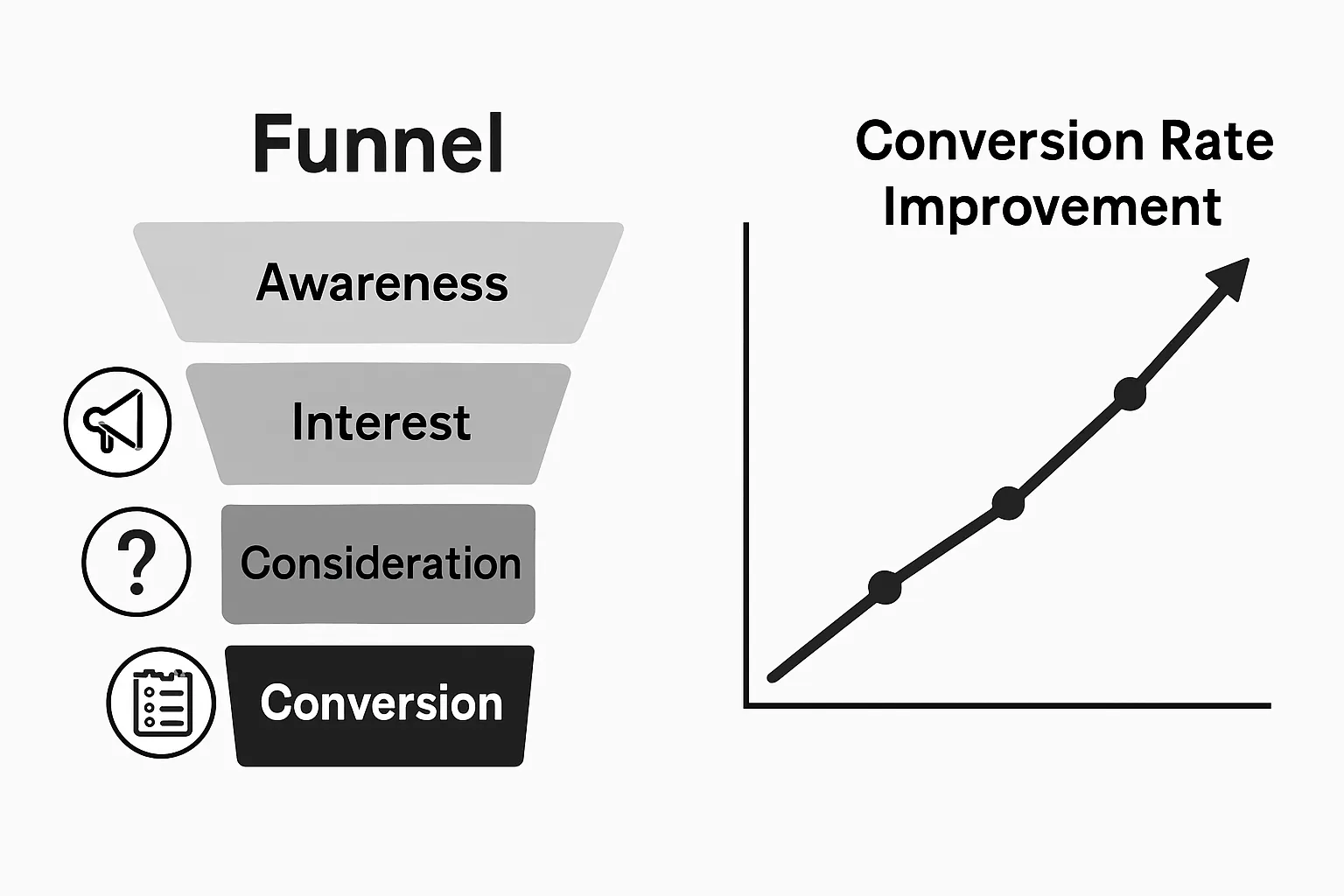
    Four stage law firm marketing funnel infographic

    • Awareness Stage: Potential clients first become aware of your law firm’s existence
    • Interest Stage: Prospects begin showing curiosity about your specific legal services
    • Consideration Stage: Clients actively evaluate whether your firm meets their legal needs
    • Conversion Stage: The critical moment when a prospect decides to hire your firm

    Strategic Purpose and Significance

    Marketing funnels provide law firms with a systematic approach to understanding client behavior and optimizing their marketing efforts. According to research from the American Bar Association, firms that implement structured marketing funnels experience up to 35% more consistent client acquisition compared to those using ad hoc marketing strategies.

    The primary objectives of a law firm marketing funnel include:

    • Systematically attracting potential clients
    • Nurturing leads through targeted communication
    • Reducing client acquisition costs
    • Creating predictable growth mechanisms
    • Building trust and credibility throughout the client journey

    By viewing client acquisition as a strategic process rather than random interactions, law firms can develop more precise, empathetic, and effective marketing approaches that resonate with their target audiences. The marketing funnel transforms unpredictable client acquisition into a measurable, repeatable system.

    The law firm marketing funnel represents more than just a theoretical framework. It is a critical strategic mechanism that transforms how legal practices approach client acquisition, retention, and growth. Explore our top marketing tips for law firms to understand practical implementation strategies.

    Addressing the Financial and Competitive Landscape

    In today’s competitive legal marketplace, law firms cannot rely solely on traditional referral networks or word-of-mouth marketing. According to research from the Legal Marketing Association, firms that implement structured marketing funnels can reduce client acquisition costs by up to 40% while simultaneously improving conversion rates.

    The financial implications of an effective marketing funnel are substantial:

    • Reduces overall marketing expenditure
    • Creates predictable revenue streams
    • Minimizes wasted marketing efforts
    • Enables more targeted client engagement
    • Provides measurable return on marketing investments

    Strategic Client Relationship Development

    A well-constructed marketing funnel goes beyond mere lead generation. It represents a sophisticated approach to understanding potential clients’ psychological journey from initial awareness to selecting legal representation. By mapping each stage of client interaction, law firms can:

    • Develop more empathetic communication strategies
    • Create targeted content addressing specific client pain points
    • Build trust through consistent and personalized engagement
    • Demonstrate expertise before direct client interaction
    • Differentiate their practice in a saturated market

    Ultimately, the law firm marketing funnel transforms client acquisition from a hit-or-miss proposition into a systematic, data-driven process. It allows legal practices to move from reactive marketing to proactive client relationship management, ensuring sustainable growth and competitive advantage in an increasingly digital legal landscape.

    client acquisition law firm

    How the Law Firm Marketing Funnel Works

    The law firm marketing funnel operates as a strategic roadmap that guides potential clients through a carefully orchestrated journey from initial contact to committed legal representation. Learn more about our specialized email marketing services to understand how targeted communication drives this process.

    Detailed Stage-by-Stage Progression

    Each stage of the marketing funnel represents a critical transition point in client acquisition. According to research from the Harvard Business Review, successful professional service marketing requires understanding these nuanced client interaction stages:

    • Top of Funnel (Awareness): Generating initial visibility through broad marketing channels
    • Middle of Funnel (Interest/Consideration): Nurturing potential client relationships
    • Bottom of Funnel (Decision/Conversion): Converting interested prospects into retained clients

    Tactical Communication and Engagement Strategies

    Effective marketing funnels leverage different communication approaches tailored to each stage of client engagement:

    • Awareness Stage: Utilize broad digital marketing techniques like SEO, content marketing, and social media presence
    • Interest Stage: Develop targeted content such as legal guides, webinars, and informative blog posts
    • Consideration Stage: Provide detailed case studies, testimonials, and personalized consultations
    • Conversion Stage: Implement direct engagement strategies like consultative meetings and transparent pricing discussions

    The complexity of the law firm marketing funnel lies in its ability to create a seamless, personalized experience that addresses potential clients specific legal needs and concerns. By systematically guiding prospects through each stage, law firms can transform casual inquiries into long-term client relationships, ultimately building a robust and sustainable practice.

    Below is a table outlining the key stages of the law firm marketing funnel and the corresponding strategies recommended for each stage to guide prospects through the client journey.

    Funnel Stage Purpose Example Strategies
    Awareness Generate initial visibility and attract leads SEO, content marketing, social media
    Interest Foster curiosity and engagement Legal guides, webinars, blog posts
    Consideration Help prospects evaluate your firm Case studies, testimonials, consultations
    Conversion Secure commitment from the client Consultative meetings, transparent pricing

    Key Concepts of Law Firm Marketing Funnels

    Understanding the fundamental concepts behind law firm marketing funnels is crucial for developing effective client acquisition strategies. Check out our latest SEO insights for law firms to understand how digital strategies intersect with marketing funnel concepts.

    Foundational Elements of Marketing Funnels

    Marketing funnels are not static structures but dynamic systems that require continuous refinement. According to research from the Legal Marketing Association, successful law firms recognize that marketing funnels are complex ecosystems with multiple interconnected components:

    • Lead Generation: Creating initial interest and attracting potential clients
    • Lead Nurturing: Developing relationships and building trust
    • Conversion Mechanisms: Transforming interested prospects into retained clients
    • Client Retention: Maintaining long-term relationships beyond initial engagement

    Strategic Measurement and Performance Indicators

    Effective law firm marketing funnels rely on precise tracking and analysis of key performance metrics. The most critical indicators include:

    • Conversion rates at each funnel stage
    • Cost per acquired client
    • Average client lifetime value
    • Engagement rates across different marketing channels
    • Return on marketing investment

    These metrics provide law firms with actionable insights into the effectiveness of their marketing strategies, enabling data-driven decision making and continuous improvement. By understanding these key concepts, legal practices can transform their marketing approach from intuitive guesswork to a systematic, measurable process that consistently attracts and retains high-quality clients.

    Real-World Applications of the Law Firm Marketing Funnel

    Practical implementation of marketing funnels transforms theoretical concepts into tangible client acquisition strategies. Discover our social media marketing strategies for law firms to see how digital platforms enhance funnel effectiveness.

    Practice Area Specific Funnel Approaches

    Different legal practice areas require nuanced marketing funnel strategies tailored to unique client needs and legal complexities. According to research from the National Law Review, specialized approaches significantly improve client conversion rates:

    • Personal Injury Law: Emphasize emotional storytelling and immediate support
    • Family Law: Focus on empathy, confidentiality, and compassionate communication
    • Business Law: Highlight expertise, track record, and strategic problem-solving
    • Criminal Defense: Prioritize trust, confidentiality, and immediate legal guidance

    Technological Integration and Optimization

    Modern law firm marketing funnels leverage advanced technological tools to streamline client acquisition and enhance engagement:

    • Automated email marketing sequences
    • Chatbots for initial client screening
    • Customer relationship management (CRM) systems
    • Targeted digital advertising platforms
    • Analytics tools for tracking funnel performance

    By combining strategic communication, technological innovation, and data-driven insights, law firms can create highly effective marketing funnels that consistently attract, engage, and convert potential clients across diverse legal practice areas.

    This table compares how funnel strategies and messaging differ for various legal practice areas to better address the unique needs and expectations of clients in each segment.

    Practice Area Key Funnel Focus Messaging Characteristics
    Personal Injury Emotional storytelling, immediate support Empathy, urgency, support
    Family Law Empathy and confidentiality Compassionate, discreet communication
    Business Law Expertise, track record Strategic, results-oriented
    Criminal Defense Trust and immediate guidance Confidential, reassuring, trustworthy

    Unlock Predictable Growth With the Right Law Firm Marketing Funnel

    Are you tired of unpredictable client intake or struggling to turn online leads into booked consultations? This article explains how understanding your law firm marketing funnel is the missing link to attracting quality clients and building a steady flow of revenue. Many legal practices feel overwhelmed by the complexity of digital outreach, unsure how to move potential clients from awareness to conversion. Without the right systematic approach, it is easy to waste money on tactics that do not deliver results.

    At LawSmiths, we turn that uncertainty into measurable growth. Our team has over 25 years of experience guiding law firms through each stage of the funnel. We provide expert digital marketing services tailored for attorneys in personal injury, criminal law, family law, and more.

    With proven experience in web design and targeted social media marketing, we help you make a lasting first impression and nurture lasting relationships.

    If you want to maximize every opportunity and build a reputation that stands out, let LawSmiths help. Take control of your client pipeline today by calling us at (833) 217-2991 before your competition does.

    Frequently Asked Questions

    What is a law firm marketing funnel?

    A law firm marketing funnel is a strategic framework that outlines the client acquisition process, guiding potential clients from awareness of the firm’s services to making the decision to hire the firm.

    What are the main stages of the law firm marketing funnel?

    The main stages of the law firm marketing funnel include: Awareness, Interest, Consideration, and Conversion. Each stage represents a different step in the potential client’s journey.

    How can law firms benefit from using a marketing funnel?

    Law firms can benefit from using a marketing funnel by systematically attracting clients, reducing acquisition costs, improving conversion rates, and creating predictable growth through targeted engagement.

    What strategies can be used at each stage of the marketing funnel?

    At the Awareness stage, firms should use SEO and content marketing. In the Interest stage, they can offer legal guides and webinars. The Consideration stage should include detailed testimonials and consultations, while the Conversion stage can focus on direct engagement through consultations and transparent pricing.

  • PPC Marketing for Lawyers: Drive Clients to Your Firm

    PPC Marketing for Lawyers: Drive Clients to Your Firm

    PPC Marketing for Lawyers: Bring Clients to Your Firm

    Law firms are pouring money into PPC campaigns, hoping to land more clients every month. But specialized legal practices demand hyper-targeted approaches, which means what works for a criminal defense lawyer could totally flop for an estate planner. Instead of casting a wide net and crossing your fingers, dialing in on the right audience and exact goals is what transforms digital ads from money pits into client magnets.

    Quick Summary

    Key Point Explanation
    1. Define Audience and Goals Understand your target clients’ demographics and set specific, measurable marketing objectives to guide your PPC strategy.
    2. Conduct In-Depth Keyword Research Utilize tools to discover high-intent keywords that reflect potential clients’ legal challenges and needs for effective targeting.
    3. Optimize Across Multiple Platforms Use various platforms like Google Ads and social media, tailoring campaigns for different legal specialties to maximize reach and effectiveness.
    4. Create Compelling Ad Copy Develop persuasive advertisements and landing pages that address client pain points while offering clear calls to action.
    5. Regularly Monitor and Adjust Campaigns Continuously track performance metrics to optimize campaigns based on real data, improving conversion rates and client acquisition.

    Step 1: Define Your Target Audience and Goals

    Successful PPC marketing for lawyers begins with strategic audience definition and precise goal setting. Understanding exactly who you want to reach and what you aim to achieve is the foundational blueprint for your entire digital advertising strategy.

    Identifying your target audience requires deep introspection about your law firm’s practice areas and ideal client demographics. Specialized legal practices demand hyper-targeted approaches. A criminal defense attorney will seek dramatically different client profiles compared to an estate planning lawyer. Consider factors such as age range, income levels, geographic location, and specific legal challenges potential clients might face.

    Start by analyzing your existing client database to uncover common characteristics. What do your most successful and satisfied clients have in common? Are they predominantly middle-aged professionals dealing with business litigation? Young families seeking personal injury representation? Retirees requiring estate planning services? These insights will help you craft laser-focused PPC campaigns that speak directly to your most promising prospects.

    Establishing clear marketing goals is equally critical. These objectives should be specific, measurable, and aligned with your firm’s broader business strategy. According to the American Bar Association’s Practice Management Guidelines, effective goals might include:

    • Generating a specific number of qualified leads per month
    • Reducing client acquisition cost by a targeted percentage
    • Increasing conversion rates from website visitors to consultation requests

    By meticulously defining your target audience and setting quantifiable goals, you create a strategic framework that transforms PPC marketing from a generic advertising approach into a precision instrument for attracting your ideal legal clients. This foundational step ensures every advertising dollar is invested with purpose and potential for meaningful return.

    Keyword research represents the critical compass that guides your PPC marketing strategy, transforming broad legal services into precisely targeted digital advertisements. This step translates your understanding of potential clients into searchable, actionable phrases that connect your law firm directly with individuals seeking legal representation.

    Strategic keyword research goes beyond simple search terms. It requires understanding the nuanced language potential clients use when experiencing legal challenges. Personal injury lawyers might target phrases like “car accident settlement lawyer” or “workers compensation attorney near me”, while family law practitioners could focus on “divorce mediation” or “child custody legal support”.

    To conduct comprehensive keyword research, leverage professional tools like Google Keyword Planner. Explore our comprehensive guide on law firm digital marketing to understand deeper strategic insights. Pay close attention to search volume, competition levels, and cost per click for each potential keyword. High intent keywords typically demonstrate stronger conversion potential. These are search terms that signal immediate legal service needs rather than casual information gathering.

    Consider the psychological landscape of legal service seekers. Most individuals searching for attorneys are experiencing significant personal stress or professional challenges. Your keywords should reflect empathy and solution-oriented language. Instead of generic terms like “lawyer”, prioritize specific, problem-solving phrases such as “legal representation for medical malpractice” or “affordable divorce attorney”.

    Verify your keyword research effectiveness by examining metrics like:

    • Average monthly search volume
    • Cost per click rates
    • Competitive difficulty scores
    • Relevance to your specific practice areas

    Successful keyword research transforms your PPC campaigns from scattered attempts into precision instruments designed to attract exactly the right clients for your legal practice.

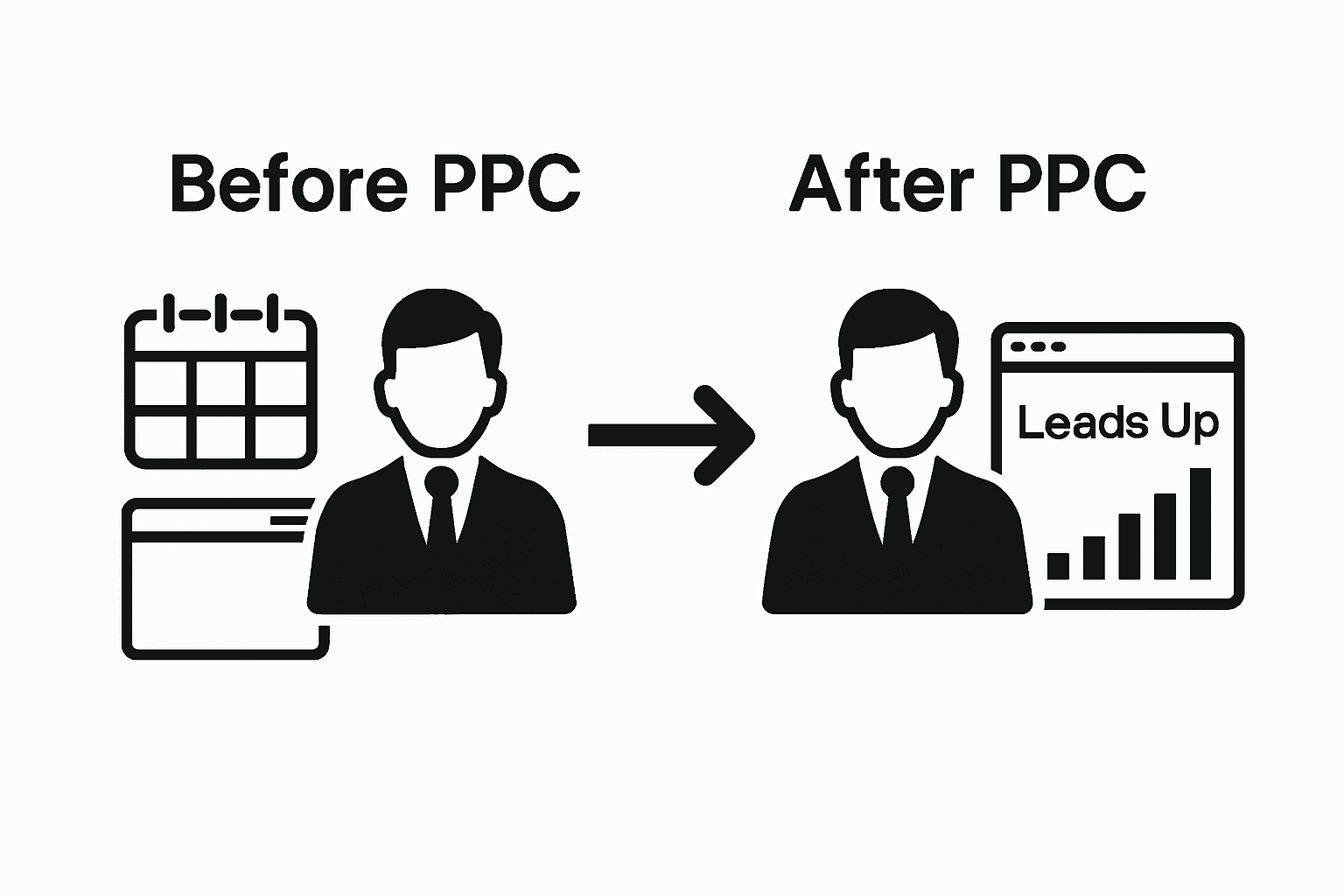
    Infographic showing before and after PPC marketing impact for lawyers

    Step 3: Set Up Your PPC Campaign Across Platforms

    Launching a successful PPC campaign requires strategic platform selection and meticulous configuration. Your digital advertising strategy must extend beyond single channels, embracing multiple platforms to maximize visibility and client acquisition potential.

    Google Ads remains the primary cornerstone of legal marketing campaigns. Create separate campaigns for different practice areas, ensuring granular control over budget allocation and targeting precision. This approach allows you to craft unique ad experiences for personal injury, criminal defense, family law, and other specialized legal services. Learn more about our comprehensive PPC marketing strategies to refine your approach.

    Beyond Google, explore platforms like Microsoft Advertising and social media channels such as LinkedIn and Facebook. Each platform offers unique targeting capabilities that can help you reach specific demographic segments. LinkedIn, for instance, allows precise professional targeting ideal for business litigation or corporate law practices, while Facebook provides robust demographic and interest based filtering.

    Below is a comparison table summarizing the strengths and best uses of popular PPC advertising platforms for law firms, based on details discussed in the article.

    Platform Strengths Best For
    Google Ads High reach, granular targeting, robust tools All legal practice areas
    Microsoft Advertising Alternative audience, lower CPCs Diversifying beyond Google
    LinkedIn Professional demographic targeting Business litigation, corporate, B2B law
    Facebook Wide demographic and interest targeting Estate planning, family, personal injury

    Developing compelling ad copy is crucial for conversion. Your advertisements must communicate immediate value and address potential client pain points concisely. Craft headlines that speak directly to legal challenges, using action-oriented language that demonstrates your firm’s expertise and commitment. Phrases like “Immediate Legal Support” or “Protecting Your Rights” can create emotional resonance with individuals seeking legal representation.

    Implement conversion tracking mechanisms across all platforms to monitor performance metrics.

    This enables real-time optimization of your campaigns, allowing you to rapidly adjust strategies based on actual user engagement. Key tracking elements should include:

    • Click-through rates
    • Cost per acquisition
    • Conversion percentages
    • Geographic performance variations

    Successful PPC campaigns for law firms demand continuous refinement. Treat your digital advertising as a dynamic ecosystem, constantly analyzing data and adapting your approach to maximize client acquisition and return on investment.

    Step 4: Create Compelling Ad Copy and Landing Pages

    Crafting persuasive ad copy and high-converting landing pages represents the critical intersection where potential clients transform from casual browsers into committed legal service seekers. Your digital marketing strategy hinges on creating messaging that resonates emotionally while providing clear, actionable information.

    Effective ad copy demands a delicate balance between empathy and professional credibility. Each advertisement must simultaneously acknowledge the potential client’s legal challenge and position your firm as the definitive solution. For personal injury lawyers, this might mean crafting headlines like “Injured? We Fight for Your Maximum Compensation,” which combine emotional understanding with a promise of tangible action. Explore our advanced marketing techniques for law firms to refine your approach.

    Landing pages serve as the critical conversion mechanism connecting your advertisement to potential client engagement. These dedicated web pages must mirror the tone and promise of your initial ad, providing a seamless user experience. Design landing pages with laser-focused clarity, eliminating navigation distractions and presenting a singular, compelling call to action. Include prominent contact forms, direct phone numbers, and brief testimonials that build immediate trust.

    Psychological triggers play a significant role in converting interested prospects. Your landing page should address potential client anxieties by highlighting key differentiators such as free initial consultations, proven track records, or specialized expertise. Use clear, benefit-driven language that transforms legal jargon into relatable promises.

    Evaluate your ad copy and landing page effectiveness through these critical metrics:

    • Conversion rates
    • Average time spent on page
    • Bounce rates
    • Form submission percentages
    • Cost per acquisition

    Remember that continuous refinement separates exceptional legal marketing from mediocre attempts.

    lawyer ad copy process Treat your digital assets as living documents, constantly testing and adapting to improve client acquisition performance.

    Step 5: Monitor and Optimize Campaign Performance Regularly

    Successful PPC marketing for lawyers demands relentless performance tracking and strategic refinement. Your digital advertising strategy is not a static blueprint but a dynamic ecosystem requiring constant attention and intelligent adaptation.

    Performance monitoring transcends simple data collection. Implement comprehensive tracking systems that provide granular insights into every aspect of your advertising campaigns. Utilize platform-specific analytics tools like Google Ads dashboard and third-party performance tracking software to gather detailed metrics. Explore advanced performance optimization techniques to elevate your marketing approach.

    Focus on key performance indicators that directly reflect campaign effectiveness. Cost per acquisition, click-through rates, and conversion percentages offer critical signals about your advertising strategy’s health. Pay close attention to demographic performance variations, identifying which audience segments respond most positively to your specific legal service advertisements.

    Systematic optimization requires a methodical approach. Develop a recurring review schedule where you systematically analyze campaign performance. This might involve weekly keyword adjustments, monthly landing page refinements, and quarterly overall strategy reassessments. Experiment with different ad variations, testing subtle messaging changes to discover what resonates most powerfully with potential clients.

    Identify and eliminate underperforming elements aggressively. High-cost keywords with minimal conversion potential should be ruthlessly pruned from your campaigns. Redirect resources toward strategies demonstrating consistent client acquisition success. Your goal is to create a lean, efficient marketing mechanism that generates maximum legal client inquiries at minimum expense.

    Validate your optimization efforts through these critical measurements:

    • Reduction in cost per lead
    • Increase in quality score
    • Improvement in conversion rates
    • Enhanced audience engagement metrics
    • Consistent client acquisition growth

    Remember that digital marketing is an ongoing journey of strategic refinement. Successful law firms treat their PPC campaigns as living, breathing entities that require continuous nurturing and intelligent adaptation.

    Step 6: Analyze Results and Adjust Strategy Accordingly

    The final stage of PPC marketing for lawyers involves comprehensive result analysis and strategic recalibration. This critical phase transforms raw data into actionable insights that will continuously refine your digital marketing approach, ensuring your law firm remains competitive and client acquisition strategies stay razor sharp.

    Data interpretation is an art form requiring nuanced understanding. Compile performance metrics from multiple platforms, creating a holistic view of your advertising effectiveness. According to Government Accountability Office research on digital strategy evaluation, systematic review processes are fundamental to sustained marketing success. Look beyond surface-level numbers to understand the deeper narrative your data presents.

    Quarterly comprehensive reviews provide the optimal cadence for meaningful strategy adjustments. Examine not just quantitative metrics like conversion rates and cost per acquisition, but qualitative elements such as client feedback, consultation quality, and long-term case conversion. Each data point tells a story about your firm’s market positioning and client attraction capabilities.

    Develop a structured approach to strategy refinement that considers multiple performance dimensions. Some practice areas might require dramatically different marketing approaches based on their unique client acquisition dynamics. A criminal defense lawyer will need different targeting strategies compared to an estate planning attorney, demanding granular, practice-specific analysis.

    Create a systematic framework for ongoing optimization that includes:

    • Quarterly comprehensive performance reviews
    • Monthly keyword and targeting adjustments
    • Continuous landing page and ad copy refinement
    • Demographic targeting recalibration
    • Budget allocation rebalancing

    Successful law firms treat their digital marketing not as a static process but as a living, breathing ecosystem of continuous improvement.

    Here is an overview table summarizing what to track and optimize at each stage of your law firm’s PPC campaign, helping you ensure ongoing improvement.

    Stage Key Metrics to Track Optimization Actions
    Audience & Goal Setting Client demographics, lead targets Refine target audience, adjust goals
    Keyword Research Search volume, CPC, intent relevance Add/replace keywords, focus on high-intent
    Campaign Setup Click-through rates, platform reach Test ad formats, expand/reduce platforms
    Ad Copy & Landing Pages Conversion %, bounce rate, form fills A/B test messaging, streamline landing pages
    Ongoing Optimization Cost per acquisition, quality score Prune poor keywords, reallocate budget
    Strategic Review Quarterly performance, client feedback Major strategy shifts, practice area focus
    Your ability to interpret data, recognize emerging trends, and swiftly adapt will determine the long term effectiveness of your PPC marketing strategy. Remember that flexibility and intelligent responsiveness are your most powerful competitive advantages in the digital marketing landscape.

    Ready to Attract More Clients With Results-Driven PPC for Your Law Firm?

    You have learned the essentials of building a strong PPC campaign in the legal space. But setting clear goals, targeting the right audience, and monitoring conversions can be overwhelming without expert support. Too many law firms spend advertising budgets without seeing a real increase in qualified leads or effective calls from local clients. If you are struggling to connect with stressed prospects searching for immediate legal help or if your PPC ads are not converting visitors into consultations, you are not alone.

    Ready to take the next steps? Call us at (833) 217-2991 for a free PPC consultation.

    Frequently Asked Questions

    What are the first steps to start a PPC campaign for my law firm?

    To start a PPC campaign, you should first define your target audience and set specific marketing goals. Analyze your existing clientele to identify common characteristics and create goals that align with your firm’s overall business strategy.

    Conduct keyword research by using tools like Google Keyword Planner to find targeted phrases that potential clients use when searching for legal help. Focus on high intent keywords that reflect the specific legal services you offer.

    What platforms should I consider for my PPC advertising?

    Google Ads should be the primary platform for your PPC campaigns, but also consider Microsoft Advertising and social media platforms like LinkedIn and Facebook. Utilizing multiple platforms allows for broader reach and better targeting capabilities.

    How can I optimize the performance of my PPC campaigns over time?

    Regularly monitor campaign performance by analyzing key performance indicators such as cost per acquisition and conversion rates. Make systematic adjustments based on this data, and continuously refine your ad copy and landing pages to improve client engagement.

  • 7 SEO Trends for Law Firms in 2025 You Need to Know

    7 SEO Trends for Law Firms in 2025 You Need to Know

    Law firms are facing a digital world that keeps moving faster every year and the rise of AI has shifted the ground under their feet like never before. Most people expect lawyers to just update their websites and hope for traffic but that approach barely scratches the surface now. With over 70 percent of legal searches happening on mobile devices and AI tools dissecting every ranking factor, the firms that break away from the old routine will be the ones clients actually discover first.

    Quick Summary

    Takeaway Explanation
    Embrace AI for SEO optimization Leverage AI tools to improve keyword targeting and content performance, enhancing your digital marketing strategies significantly.
    Focus on local SEO tactics Implement local SEO strategies to connect with clients in your area, optimizing profiles and gathering reviews to enhance visibility.
    Prioritize user experience in design Create intuitive website designs that are accessible, responsive, and easy to navigate, improving client engagement and search rankings.
    Adapt content for voice search Optimize legal content to suit voice queries with conversational language and FAQs, addressing potential client questions directly.
    Monitor algorithm changes continuously Stay informed on search engine updates and adapt strategies proactively to maintain visibility and improve search rankings.

    1: Embrace AI-Driven SEO Tools for Optimization

    The legal marketing landscape is rapidly transforming with artificial intelligence revolutionizing search engine optimization strategies for law firms. AI-powered SEO tools are no longer optional but critical for staying competitive in 2025. These sophisticated technologies offer unprecedented capabilities to analyze complex search patterns, predict user intent, and optimize digital content with remarkable precision.

    Law firms can leverage AI tools to gain significant advantages in their digital marketing efforts. Advanced SEO content strategies become more accessible through machine learning algorithms that can quickly assess keyword relevance, content performance, and competitive positioning.

    According to Gartner Research, AI is expected to dramatically reshape search engine optimization across industries. For law firms, this means implementing tools that can:

    • Automatically identify high-performing keywords specific to legal practice areas
    • Generate data-driven content recommendations
    • Predict potential ranking improvements with unprecedented accuracy

    The most effective AI SEO tools for law firms in 2025 will integrate multiple functionalities. Machine learning algorithms can now analyze website performance, suggest technical improvements, and even predict potential user engagement metrics with remarkable accuracy. These tools go beyond traditional keyword research, offering holistic insights into digital marketing strategies.

    Professional law firms must invest in AI-driven SEO technologies that provide comprehensive analytics, real-time performance tracking, and predictive optimization recommendations. By embracing these advanced tools, legal practices can develop more targeted, efficient, and successful digital marketing approaches that drive meaningful client engagement.

    2: Focus on Local SEO for Increased Visibility

    Local search engine optimization has become mission-critical for law firms seeking to attract clients within their specific geographic regions. Geographical targeting represents a strategic approach to digital marketing that allows legal practices to connect directly with potential clients in their immediate service area.

    Local SEO strategies have evolved significantly, moving beyond simple location-based keywords to more sophisticated, nuanced approaches. According to BrightLocal’s Local Consumer Survey, 87% of consumers read online reviews for local businesses in 2023, highlighting the critical importance of local digital presence.

    Law firms must implement comprehensive local SEO tactics to stand out in competitive markets. Key strategies include:

    • Optimizing Google Business Profile with accurate and comprehensive information
    • Generating consistent local citations across multiple online directories
    • Collecting and managing client reviews strategically

    Geographic specificity now matters more than ever. Search engines increasingly prioritize hyper-local content that demonstrates genuine community connection. This means law firms should develop content that speaks directly to local legal challenges, reference local court systems, and showcase community involvement.

    Mobile optimization plays a crucial role in local SEO success. With over 60% of local searches now performed on mobile devices, responsive design and fast-loading websites become non-negotiable. Law firms must ensure their digital platforms provide seamless experiences across all devices, with clear contact information and easy navigation.

    Understanding local search intent requires deeper analytics and more sophisticated targeting. Firms that invest in granular geographic data and develop hyperlocal content strategies will gain significant competitive advantages in attracting potential clients searching for specialized legal services in their immediate area.

    3: Prioritize User Experience in Website Design

    User experience has become the cornerstone of effective digital marketing for law firms in 2025. Website design now extends far beyond aesthetic appeal, focusing intensely on creating intuitive, accessible, and engaging digital environments that convert potential clients.

    Custom website design strategies are transforming how legal practices communicate their value proposition online. According to Google’s Web Vitals Research, user experience metrics directly impact search engine rankings, making seamless website performance crucial for law firm visibility.

    Law firms must reimagine their digital interfaces with a client-centric approach. Critical elements of superior user experience include:

    • Creating clear, straightforward navigation paths
    • Developing mobile-responsive design
    • Ensuring fast page loading speeds

    Accessibility has emerged as a non-negotiable aspect of modern web design. Websites must accommodate users with diverse abilities, incorporating features like screen reader compatibility, high-contrast color schemes, and keyboard navigation. These considerations not only improve user experience but also demonstrate a law firm’s commitment to inclusivity.

    The modern legal website must balance professional credibility with approachable design. Complex legal information needs to be presented in digestible formats, using clean typography, strategic whitespace, and visual hierarchies that guide users seamlessly through content. Interactive elements like chatbots, easy contact forms, and clear call-to-action buttons can significantly enhance user engagement.

    Search engines increasingly prioritize websites that offer superior user experiences. Firms that invest in thoughtful, user-centered design will not only attract more potential clients but also signal technical sophistication and client-focused approach in an increasingly competitive digital marketplace.

    Voice search technology is rapidly transforming how potential clients discover and interact with legal services. As smart devices become increasingly integrated into daily life, law firms must adapt their digital strategies to accommodate this emerging search paradigm.

    Digital marketing strategies now require sophisticated approaches to voice search optimization. According to ComScore Research, over 50% of all searches are expected to be voice-based by 2025, presenting a significant opportunity for forward-thinking legal practices.

    Successful voice search optimization demands a nuanced understanding of conversational language and user intent. Law firms must restructure their content to address natural language queries, focusing on:

    • Implementing conversational, question-based content
    • Utilizing long-tail keywords that mirror spoken language
    • Creating FAQ sections that directly answer potential client questions

    Semantic search has become crucial in voice query optimization. This means developing content that understands and responds to the contextual meaning behind legal inquiries, not just matching specific keywords. Search algorithms now prioritize content that provides comprehensive, direct answers to complex legal questions.

    Mobile responsiveness and local SEO play critical roles in voice search success. Many voice searches are location-specific, with users seeking immediate legal assistance near them. Law firms must ensure their digital presence includes precise local information, clear contact details, and geographically relevant content that aligns with voice search algorithms.

    Technical optimization is equally important. Structured data markup, fast website loading speeds, and clear, concise content help search engines understand and prioritize a law firm’s digital presence in voice search results. By anticipating and addressing potential client questions through strategic content design, law firms can position themselves at the forefront of this transformative search technology.

    5: Implement Video Content to Engage Clients

    Video content has emerged as a powerful tool for law firms seeking to humanize their digital presence and connect more intimately with potential clients. Multimedia communication transcends traditional text-based marketing, offering dynamic storytelling opportunities that build trust and demonstrate expertise.

    Video animation strategies are transforming how legal services communicate complex information. According to Wyzowl’s Video Marketing Statistics, 89% of people say watching a video has convinced them to purchase a product or service, highlighting the persuasive power of visual content.

    Effective video content for law firms should focus on:

    • Explaining complex legal concepts in accessible language
    • Showcasing attorney expertise and firm personality
    • Addressing common client concerns and questions

    Search engine algorithms now prioritize websites with rich, engaging multimedia content. Video content increases average time spent on a website, reduces bounce rates, and signals to search engines that the site provides valuable user experience. This directly impacts search rankings and online visibility for law firms.

    Technical optimization remains crucial in video content strategy. Law firms must ensure videos are properly tagged, transcribed, and embedded with structured data to maximize search engine visibility. Short-form educational content, client testimonial videos, and practice area explainer videos can significantly enhance a firm’s digital marketing approach.

    The most successful law firms in 2025 will treat video not as an optional marketing tool, but as a core communication strategy. By creating authentic, informative, and professionally produced video content, legal practices can differentiate themselves in an increasingly competitive digital marketplace, building stronger connections with potential clients through visual storytelling.

    6: Optimize for Mobile-First Indexing Effectively

    Mobile optimization has transformed from a recommended strategy to an absolute necessity for law firms in 2025. With search engines exclusively using mobile versions of websites for ranking and indexing, legal practices must prioritize seamless mobile experiences.

    Technical SEO approaches now require comprehensive mobile-first design strategies. According to Google’s Mobile Search Trends Report, over 70% of legal searches now originate from mobile devices, underscoring the critical importance of mobile-responsive design.

    Successful mobile optimization for law firms involves several key considerations:

    • Ensuring responsive design across all device sizes
    • Implementing fast page loading speeds
    • Creating touch-friendly navigation interfaces

    Page speed remains a crucial factor in mobile indexing. Law firm websites must minimize loading times by compressing images, leveraging browser caching, and reducing unnecessary scripts. Google’s Core Web Vitals have established strict performance metrics that directly impact search rankings.

    Content adaptation is equally important. Mobile users expect concise, easily digestible information. Long paragraphs must be broken into shorter segments, with clear headings and strategic use of white space. Contact forms, phone numbers, and call-to-action buttons need to be prominently displayed and easily clickable on smaller screens.

    Law firms must also consider technical elements like structured data, metadata, and schema markup that work effectively across mobile platforms. By creating a holistic mobile experience that balances aesthetic appeal with functional design, legal practices can ensure they remain visible and accessible in an increasingly mobile-driven digital landscape.

    7: Monitor and Adapt to Algorithm Changes Regularly

    Search engine algorithms are continuously evolving, presenting both challenges and opportunities for law firms seeking digital visibility. Staying ahead requires a proactive, dynamic approach to search engine optimization that prioritizes ongoing learning and strategic adaptation.

    Digital marketing strategies must now incorporate robust monitoring and rapid response mechanisms. According to Moz’s Algorithm Update Tracking, search engines implement hundreds of algorithmic changes annually, making continuous education and flexibility crucial for maintaining competitive search rankings.

    Successful algorithm adaptation involves several strategic approaches:

    • Establishing consistent performance tracking systems
    • Maintaining flexible content strategies
    • Investing in ongoing SEO education and training

    Artificial intelligence has significantly transformed algorithm complexity, requiring law firms to develop more sophisticated tracking and response mechanisms. Machine learning algorithms now evaluate websites based on increasingly nuanced criteria, including user experience metrics, content relevance, and comprehensive topical authority.

    Law firms must develop robust analytics frameworks that provide real-time insights into website performance. This means implementing advanced tracking tools, conducting regular comprehensive audits, and maintaining a nimble approach to content and technical optimization. Professional development and continuous learning become critical, with marketing teams needing to stay informed about emerging trends and algorithmic shifts.

    The most successful legal practices in 2025 will treat search engine optimization as a dynamic, ongoing process.

    Below is a comprehensive table summarizing the 7 key SEO trends for law firms in 2025, outlining their focus areas, benefits, and main actions recommended in the article.

    Trend Focus Area / Description Key Benefits Main Actions/Recommendations
    AI-Driven SEO Tools Use artificial intelligence for smarter keyword targeting and content analysis Enhanced precision in SEO, higher rankings Leverage AI for keyword research, content optimization, and analytics
    Local SEO Optimize for geographic searches and local client engagement Increased local visibility, more client leads Update Google profiles, get reviews, publish hyperlocal content
    User Experience in Website Design Create intuitive, accessible, and mobile-responsive websites Higher search rankings, better client engagement Prioritize navigation, page speed, accessibility, and clean design
    Voice Search Optimization Adapt content for conversational and voice-based legal queries Greater reach via voice-enabled devices Use natural language, long-tail keywords, and FAQ sections
    Video Content Employ video to explain legal topics and showcase expertise Builds trust, increases time on site, boosts ranking Produce educational videos, client testimonials, and practice explainers
    Mobile-First Indexing Fully optimize for mobile devices as primary search indexing basis Improved search placement, better mobile experience Ensure responsive design, compress images, use touch-friendly elements
    Algorithm Monitoring & Adaptation Continuously track and adapt to frequent search engine algorithm updates Sustained search visibility, reduced negative impacts Invest in analytics, ongoing SEO education, and flexible strategies

    Are you feeling overwhelmed by the rapid changes in SEO and digital trends shaping the legal industry? The article highlighted challenges most law firms face: adapting to AI-driven SEO tools, improving local visibility, prioritizing user experience, and maximizing the impact of mobile and video content. With fierce competition and complex algorithm updates, missing these trends can leave your firm behind—making it harder to attract quality clients and stand out online.

    Your law firm deserves a partner who understands both the intricacies of digital marketing and the realities of legal practice. LawSmiths brings more than 25 years of specialized expertise in law firm SEO, website design, and digital campaign execution. If you want to turn uncertainty into growth, start by getting a free consultation.

    Frequently Asked Questions

    Law firms should focus on AI-driven SEO tools, local SEO strategies, user experience design, voice search optimization, video content, mobile-first indexing, and monitoring algorithm changes.

    How can AI tools improve SEO for law firms?

    AI tools can analyze search patterns, predict user intent, optimize content, identify high-performing keywords, and provide data-driven content recommendations to enhance digital marketing efforts.

    Why is local SEO important for law firms?

    Local SEO is critical as it helps law firms connect with potential clients in their geographical area, improves visibility in local search results, and increases the likelihood of attracting local clients.

    How can law firms optimize their websites for mobile-first indexing?

    Law firms can optimize for mobile-first indexing by ensuring responsive design, fast page loading speeds, concise content, and touch-friendly navigations to enhance user experiences on mobile devices.

  • Understanding What is On-Page SEO for Law Firms

    Understanding What is On-Page SEO for Law Firms

    Law firms are in a race to stand out online, and the way they shape their website content makes all the difference. Here is a number that might surprise you. Ninety-six percent of people seeking legal advice start their search online. Most lawyers keep pouring money into ads or overlook their site’s structure completely. But focusing on on-page SEO gives law firms a real shot to become the first choice for clients searching for help, even against much bigger practices.

    Quick Summary

    Takeaway Explanation
    On-page SEO builds digital trust Optimizing content establishes credibility, appealing to potential clients seeking legal guidance.
    Content quality is crucial for ranking High-quality, well-structured content directly influences search engine visibility and user engagement.
    Target specific legal queries Craft content that addresses common legal questions to attract organic traffic from potential clients.
    Utilize technical SEO elements Implement schema markup and ensure website performance to enhance user experience and search rankings.
    Investing in SEO lowers client acquisition costs A robust on-page SEO strategy can reduce marketing spend while increasing organic traffic and conversions.

    On-page SEO for law firms represents a strategic approach to optimizing digital content specifically tailored to legal marketing needs. Unlike generic SEO practices, legal on-page optimization demands a nuanced understanding of how potential clients search for legal services online and how search engines evaluate legal content.

    In the legal digital marketing ecosystem, on-page SEO goes beyond traditional keyword placement. It involves creating content that demonstrates expertise, authoritativeness, and trustworthiness specifically for legal audiences. Research from Search Engine Journal indicates that law firms must craft content that not only ranks well but also addresses complex legal queries with precision and clarity.

    Key components of legal on-page SEO include:

    • Precise legal terminology usage
    • Creating content that answers specific legal questions
    • Structuring information for easy comprehension
    • Implementing schema markup for legal service descriptions

    Successful on-page SEO for law firms requires meticulous attention to technical details. This includes optimizing title tags with specific practice area keywords, crafting meta descriptions that highlight unique legal expertise, and ensuring website architecture supports easy navigation for potential clients seeking legal information.

    Search engines like Google prioritize websites that provide comprehensive, authoritative content. For law firms, this means developing in-depth practice area pages, publishing informative blog posts about legal trends, and presenting information in a manner that showcases professional credibility. Moz’s SEO research emphasizes that content quality trumps quantity in legal digital marketing.

    Lawyers and legal marketing professionals must recognize that on-page SEO is not just about visibility but about establishing digital trust. By strategically optimizing web pages, law firms can position themselves as go-to resources for potential clients searching for legal guidance online.

    To help distinguish the technical and content-focused aspects of on-page SEO for law firms, the table below compares their key features and roles.

    Aspect Content Optimization Technical SEO Optimization
    Primary Focus High-quality, informative legal content Website performance and search engine accessibility
    Key Activities Using precise legal terminology, addressing client questions Schema markup, mobile responsiveness, site speed
    Outcome Establishes expertise, attracts organic traffic Enhances user experience, supports higher rankings
    Example Elements Practice area pages, legal blogs, FAQs Optimized HTML, internal linking, site architecture
    Importance Builds digital trust, answers user intent Ensures technical credibility, improves site rankings

    Learn more about our comprehensive digital marketing approach for law firms.

    Why On-Page SEO Matters for Law Firms

    On-page SEO represents a critical strategic investment for law firms seeking to establish a robust digital presence and attract potential clients in an increasingly competitive online marketplace. Unlike traditional marketing methods, on-page SEO provides a targeted approach to visibility that directly connects legal practices with individuals actively seeking legal guidance.

    The Economic Impact of Strategic Online Positioning

    Legal practices that invest in comprehensive on-page SEO strategies can experience significant economic advantages. According to research from the American Bar Association, 96% of people seeking legal advice begin their search online, making digital visibility paramount. This statistic underscores why on-page SEO is not merely a technical exercise but a fundamental business development strategy.

    Key economic benefits of robust on-page SEO include:

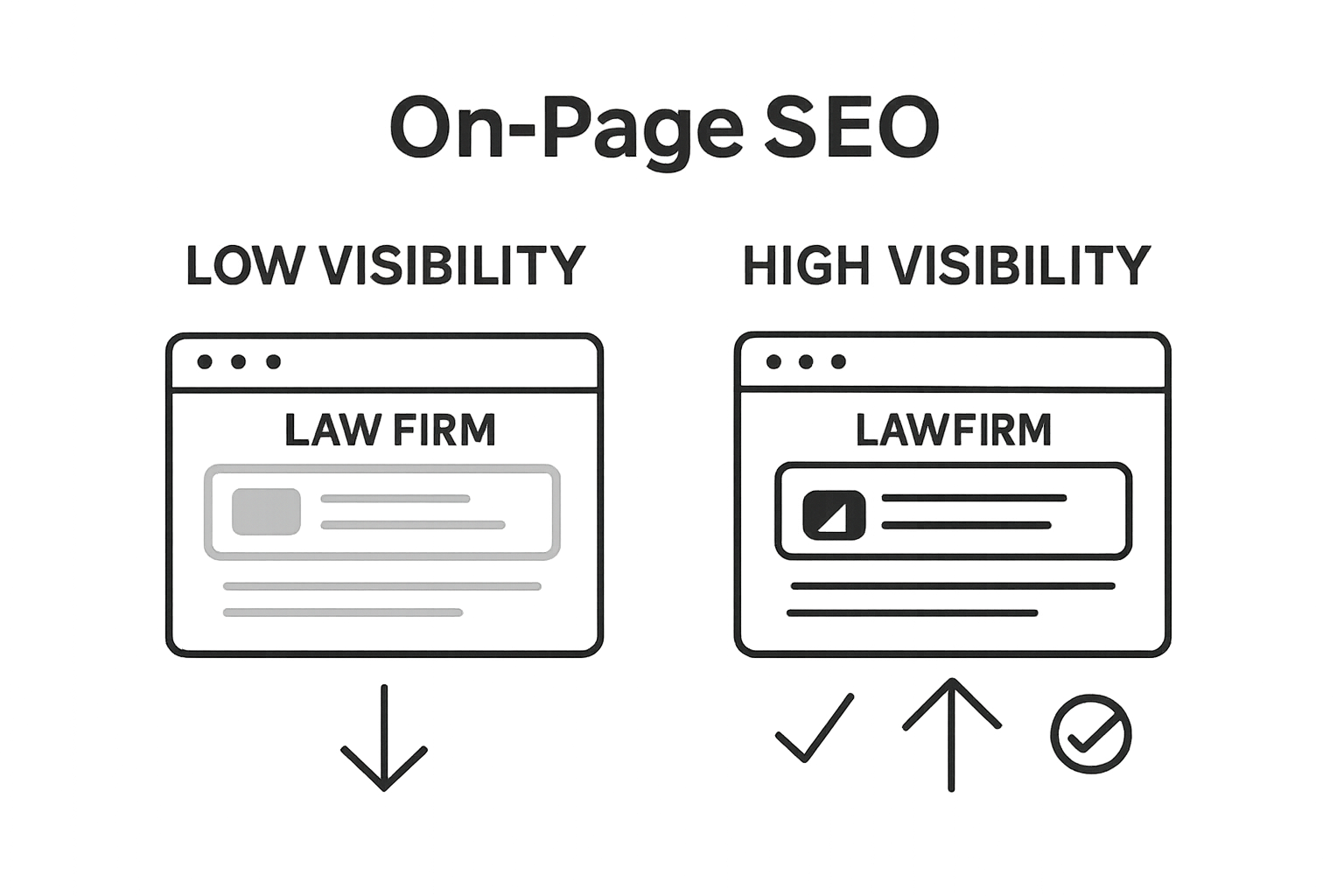
    Infographic comparing law firm website visibility before and after on-page SEO

    • Reducing client acquisition costs
    • Increasing organic website traffic
    • Establishing credibility without expensive advertising
    • Improving conversion rates from website visitors to actual clients

    Building Digital Trust Through Optimized Content

    Search engines like Google prioritize websites that demonstrate expertise, authoritativeness, and trustworthiness. For law firms, this means creating content that not only ranks well but also genuinely serves potential clients’ informational needs. By developing detailed practice area pages, answering common legal questions, and presenting complex information in an accessible manner, law firms can build digital credibility.

    Moreover, on-page SEO helps law firms differentiate themselves in a saturated market. Research from Legal Marketing Association reveals that law firms with sophisticated online content strategies are 3.5 times more likely to be considered by potential clients compared to firms with minimal digital presence.

    The strategic implementation of on-page SEO is no longer optional but essential. Explore our comprehensive SEO content writing services to transform your law firm’s digital marketing approach and connect with more potential clients effectively.

    How On-Page SEO Affects Website Visibility and Traffic

    On-page SEO serves as a critical mechanism for law firms to enhance their digital visibility and attract targeted organic traffic. By strategically optimizing website elements, legal practices can significantly improve their search engine rankings and draw potential clients searching for specific legal services.

    Search Engine Ranking Mechanisms

    Research from Ahrefs demonstrates that on-page optimization directly influences how search engines understand and rank legal websites. Search algorithms evaluate multiple factors including content relevance, site structure, and user experience to determine a website’s position in search results. For law firms, this means meticulously crafting content that signals expertise and reliability to both search engines and potential clients.

    Key ranking factors for legal websites include:

    • Precise keyword targeting related to specific legal practice areas
    • High-quality, informative content addressing client legal questions
    • Clean, logical website architecture
    • Fast page loading speeds
    • Mobile-responsive design

    Organic Traffic Generation Strategies

    Successful on-page SEO transforms a law firm’s website from a digital brochure into an active client acquisition tool. By developing content that directly answers potential clients’ legal queries, firms can attract highly qualified organic traffic. This approach goes beyond generic advertising by connecting directly with individuals actively seeking legal guidance.

    Google’s Search Quality Evaluator Guidelines emphasize the importance of creating authoritative content that demonstrates expertise, particularly in professional service industries like law. This means developing comprehensive practice area pages, detailed blog posts, and resources that provide genuine value to potential clients.

    The cumulative effect of robust on-page SEO is a self-reinforcing visibility cycle. As search engines recognize the quality and relevance of a law firm’s content, they progressively improve the site’s rankings, leading to increased organic traffic and potential client interactions. Learn more about our technical SEO approaches to maximize your digital marketing effectiveness.

    On-page SEO for legal websites requires a sophisticated approach that balances technical optimization with authoritative content creation. Unlike generic websites, law firm digital platforms must simultaneously satisfy complex search engine algorithms and meet potential clients’ informational needs.

    Content Optimization Strategies

    Google’s SEO Starter Guide emphasizes the critical importance of creating high-quality, contextually relevant content. For legal websites, this means developing comprehensive practice area pages that demonstrate deep expertise and address specific client concerns with precision and clarity.

    Critical content optimization elements include:

    law firm content optimization

    • Utilizing precise legal terminology
    • Developing long-form, informative content
    • Addressing frequently asked legal questions
    • Incorporating jurisdiction-specific information
    • Maintaining updated and accurate legal insights

    Technical SEO Fundamentals

    Technical optimization goes beyond content creation, involving sophisticated website structure and performance considerations. Search engines evaluate legal websites through complex algorithms that assess multiple technical factors. Proper HTML structure, semantic markup, and clear navigation pathways become crucial for establishing digital credibility.

    Key technical optimization components require law firms to:

    • Implement schema markup for legal services
    • Ensure mobile responsiveness
    • Optimize page loading speeds
    • Create clear, logical website hierarchies
    • Develop comprehensive internal linking strategies

    User Experience and Search Intent

    Successful on-page SEO transcends technical checklist completion. Search Engine Journal highlights that modern optimization focuses on holistically satisfying user search intent. For law firms, this means creating content that not only ranks well but genuinely helps potential clients understand complex legal concepts and potential solutions.

    By integrating comprehensive content strategies with technical precision, law firms can transform their websites from mere digital brochures into powerful client acquisition platforms.

    The following table summarizes key components of effective on-page SEO for legal websites, helping visualize how each element contributes to successful digital marketing for law firms.

    Element Description
    Legal Terminology Usage Incorporating precise, relevant language for credibility
    Comprehensive Content Developing in-depth, informative pages and resources
    Schema Markup Implementation Enhancing search visibility with structured data
    Mobile Responsiveness Ensuring site functions well on all devices
    Fast Page Loading Speeds Improving user experience and search rankings
    Internal Linking Strategies Navigating users to related legal topics and services

    Ready to Turn Your Law Firm Website Into a Client Magnet?

    Is your law firm struggling to stand out online despite creating detailed content and following SEO best practices? The article highlights how vital on-page SEO is for legal websites, especially when it comes to building trust, using precise terminology, and attracting high-quality leads. Pain points like poor visibility in search results, a lack of authority in your practice area, and missed opportunities with potential clients are common challenges for firms that approach digital marketing without expert guidance.

    If you want your website to rank higher, speak to the needs of your prospective clients, and convert traffic into signed cases, you need a partner who knows the legal market inside and out. LawSmiths brings over 25 years of experience helping law firms like yours achieve measurable growth. Discover how our tailored SEO content writing services address the unique demands of legal marketing, or explore our advanced search engine optimization strategies for law firms that combine technical expertise with industry insight.

    Take control of your law firm’s online future today. Visit LawSmiths now and schedule a personalized consultation to see real results faster.

    Frequently Asked Questions

    What is on-page SEO for law firms?

    On-page SEO for law firms refers to the process of optimizing website content specifically tailored to meet the needs of legal marketing. This includes using precise legal terminology, addressing complex legal queries, and ensuring content is structured for clarity and comprehension.

    On-page SEO is crucial for law firms as it helps enhance digital visibility and connect with potential clients actively searching for legal services. A strong on-page SEO strategy can lead to reduced client acquisition costs and increased organic website traffic.

    How does on-page SEO impact a law firm’s website traffic?

    On-page SEO directly influences a law firm’s website visibility in search engine results. By optimizing content and website structure, law firms can attract highly qualified organic traffic and improve their search rankings, ultimately leading to higher conversion rates from visitors to clients.

    Key elements of effective on-page SEO for law firms include utilizing precise legal terminology, developing high-quality, informative content that addresses client questions, implementing technical optimizations like schema markup, and ensuring user-friendly website navigation.


  • What is Personal Injury Marketing? Understanding Its Impact

    What is Personal Injury Marketing? Understanding Its Impact

    Understanding The Impact of Personal Injury Marketing

    Personal injury marketing sounds like another legal buzzword, but it drives real impact for law firms and clients alike. Most people are surprised that smart digital targeting can increase client acquisition rates by up to 40 percent for professional services. Yet, the real magic lies in how these campaigns blend empathy with precision, helping injured individuals connect with attorneys at moments when trust feels almost impossible to build.

    Quick Summary

    Takeaway Explanation
    Empathy is crucial in personal injury marketing Attorneys should communicate understanding and care for clients’ emotional challenges during legal processes.
    High-quality leads are essential for law firms Effective personal injury marketing strategies help firms attract individuals seeking legal representation when most vulnerable.
    Content marketing builds trust and authority Providing informative, empathetic content demonstrates expertise and supports clients through legal complexities.
    Digital targeting enhances client engagement Utilizing advanced technologies like SEO and targeted ads can significantly improve potential client acquisition rates.
    Future marketing trends emphasize human connection The evolution of personal injury marketing will focus on delivering personalized, ethical, and emotionally intelligent communication.

    Defining Personal Injury Marketing: Key Concepts

    Personal injury marketing represents a specialized digital strategy designed to connect attorneys with potential clients who have experienced physical or psychological harm due to accidents, negligence, or intentional actions. Unlike traditional legal advertising, personal injury marketing focuses on creating targeted, empathetic communication channels that help individuals understand their legal rights and potential compensation opportunities.

    The Core Purpose of Personal Injury Marketing

    At its fundamental level, personal injury marketing aims to accomplish three critical objectives for law firms and legal practitioners:

    • Generate high-quality leads from individuals seeking legal representation
    • Build trust and credibility with potential clients during vulnerable moments
    • Educate potential clients about their legal options and rights after experiencing injury

    The strategy goes beyond simple advertising by providing valuable information and emotional support.

    Infographic showing the three core goals of personal injury marketing: Leads, Trust, Education According to Cornell Law School’s Legal Information Institute, personal injury law encompasses a wide range of scenarios where individuals suffer harm, and effective marketing must reflect this complexity.

    Strategic Communication and Client Engagement

    Successful personal injury marketing requires a nuanced understanding of potential clients’ psychological and emotional states. Attorneys must craft messaging that demonstrates genuine empathy, professional expertise, and a commitment to achieving justice. This involves creating content that addresses common concerns, explains legal processes, and showcases the firm’s track record of successful case resolutions.

    These communication strategies often leverage multiple digital channels, including:

    • Targeted search engine advertising
    • Informative website content
    • Social media engagement
    • Detailed case study presentations

    Law firms can learn more about specialized digital marketing approaches that help them effectively reach and support potential clients during challenging legal journeys.

    The following table organizes different digital channels and their roles in successful personal injury marketing, providing a clear comparison of approaches discussed in the article.

    Digital Channel Purpose Example Use
    Search Engine Advertising Reach potential clients actively searching for help Targeted Google or Bing ads for personal injury terms
    Informative Website Content Educate clients and build credibility Legal guides, FAQs, detailed service pages
    Social Media Engagement Foster connections and share updates Firm updates, client stories, interactive posts
    Case Study Presentations Demonstrate expertise through real results Detailed accounts of previous client outcomes
    Video Testimonials Humanize the firm and build trust Client journey videos, attorney explanations

    By combining technological tools, compassionate communication, and strategic outreach, personal injury marketing transforms how legal services are discovered, evaluated, and ultimately selected by individuals seeking representation and justice.

    The Importance of Personal Injury Marketing for Law Firms

    Personal injury marketing has become a critical strategy for law firms seeking to differentiate themselves in an increasingly competitive legal landscape. By implementing targeted marketing approaches, attorneys can effectively connect with potential clients during their most vulnerable moments, transforming how legal services are discovered and accessed.

    Economic and Client Acquisition Significance

    The economic implications of robust personal injury marketing are profound. Law firms invest in these strategies to:

    • Generate consistent, high-quality client leads
    • Establish credibility in a saturated legal market
    • Maximize return on marketing investments
    • Build long-term client relationships

    Research from the American Bar Association indicates that effective legal marketing can significantly increase a firm’s client acquisition rates and overall revenue potential. Personal injury attorneys particularly benefit from strategic digital outreach that addresses potential clients’ immediate legal needs.

    Building Trust Through Targeted Communication

    Successful personal injury marketing transcends traditional advertising by creating meaningful connections. Law firms must demonstrate genuine understanding of clients’ emotional and legal challenges. This involves developing communication strategies that:

    • Provide clear, compassionate legal guidance
    • Explain complex legal processes in an accessible language
    • Showcase the firm’s expertise and track record
    • Address potential clients’ immediate concerns and fears

    By leveraging empathetic messaging and professional storytelling, attorneys can transform marketing from a transactional interaction into a trust-building opportunity. Learn more about developing comprehensive law firm marketing strategies that resonate with potential clients.

    Personal injury marketing represents more than advertising—it is a sophisticated approach to connecting human experiences with professional legal support, ultimately bridging the gap between those who need legal representation and attorneys prepared to provide exceptional service.

    The table below highlights key statistics and research findings from the article, illustrating the measurable impact of personal injury marketing strategies for law firms.

    Statistic or Study Source Key Finding
    Increase in client acquisition rates by digital targeting Article overview / Google Research Up to 40% improvement in client acquisition rates for professional services
    Digital campaign engagement rates Nielsen’s Digital Consumer Insights Personalized digital campaigns can increase engagement by up to 60% for professional services
    Personalized digital experience conversion rates Gartner’s Technology Research Personalized digital experiences can increase conversion rates by up to 45%
    Marketing impact on law firm revenue American Bar Association Research Effective legal marketing increases client acquisition rates and overall revenue potential

    Core Strategies in Personal Injury Marketing

    Personal injury marketing requires sophisticated, multifaceted strategies that blend digital technology, psychological understanding, and targeted communication approaches. Successful law firms recognize that effective marketing goes far beyond simple advertising, demanding a nuanced approach that addresses potential clients’ complex emotional and legal needs.

    Digital Targeting and Search Optimization

    Modern personal injury marketing leverages advanced digital technologies to reach potential clients precisely when they need legal assistance. Key strategies include:

    • Implementing search engine optimization (SEO) techniques specific to personal injury keywords
    • Creating geographically targeted digital advertising campaigns
    • Developing content that addresses specific injury scenarios
    • Utilizing retargeting advertisements to maintain client engagement

    Google’s Digital Marketing Research suggests that strategic digital targeting can increase client acquisition rates by up to 40% for professional services.

    Content-Driven Trust Building

    Content marketing plays a pivotal role in personal injury digital strategies. Law firms must produce authoritative, empathetic content that demonstrates legal expertise while providing genuine support. This involves developing:

    • Comprehensive legal guides explaining complex injury claims
    • Detailed case study narratives showcasing successful representations
    • Video content featuring attorney insights and client testimonials
    • Informative blog posts addressing common legal questions

    By creating value-driven content, attorneys transform marketing from a transactional interaction into a trust-building opportunity. Explore comprehensive digital marketing approaches for legal practices that can elevate your firm’s online presence.

    Personal injury marketing represents a strategic fusion of technological innovation, psychological insight, and legal communication, designed to connect compassionate legal representation with individuals navigating challenging personal circumstances.

    lawyers looking at client acquisition graph

    Real-World Examples of Effective Personal Injury Marketing

    Personal injury marketing success is measured not just by client acquisition, but by the ability to communicate complex legal narratives effectively and compassionately. Innovative law firms are transforming traditional marketing approaches by developing strategic, empathetic communication methods that resonate with potential clients during their most vulnerable moments.

    Digital Campaign Effectiveness

    Leading personal injury law firms have demonstrated remarkable marketing strategies that combine technological sophistication with human-centered storytelling. Successful campaigns typically share several key characteristics:

    • Utilizing targeted social media advertisements
    • Creating interactive website content explaining legal processes
    • Developing multilingual marketing materials
    • Implementing geographically precise digital targeting

    Nielsen’s Digital Consumer Insights reveal that personalized digital campaigns can increase engagement rates by up to 60% for professional services.

    Storytelling and Client Connection

    The most compelling personal injury marketing approaches transcend traditional advertising by focusing on authentic client experiences. This involves:

    • Producing video testimonials that highlight client journeys
    • Sharing detailed case study narratives
    • Creating informative content addressing specific injury scenarios
    • Demonstrating genuine empathy and legal expertise

    By humanizing legal services, attorneys transform marketing from a transactional interaction into a meaningful connection. Effective personal injury marketing represents a delicate balance between technological precision and human understanding, ultimately bridging the gap between legal expertise and individual human experiences.

    The landscape of personal injury marketing is rapidly evolving, driven by technological advancements, changing consumer behaviors, and increasingly sophisticated digital communication strategies. Law firms must anticipate and adapt to emerging trends to remain competitive and effectively serve potential clients in an increasingly complex digital environment.

    Technological Innovation and Client Engagement

    Emerging technologies are revolutionizing how personal injury law firms connect with potential clients. Cutting-edge marketing approaches will increasingly incorporate:

    • Artificial intelligence-powered chatbots for initial client consultations
    • Advanced data analytics for precise audience targeting
    • Virtual reality simulations explaining complex legal scenarios
    • Personalized digital communication platforms

    Gartner’s Technology Research indicates that personalized digital experiences can increase client conversion rates by up to 45% for professional services.

    Ethical and Empathetic Digital Strategies

    Future personal injury marketing will demand a sophisticated balance between technological efficiency and genuine human connection. Progressive law firms will focus on:

    • Creating emotionally intelligent digital communication
    • Developing transparent, accessible legal information
    • Implementing multilingual and culturally sensitive marketing approaches
    • Utilizing interactive digital storytelling techniques

    Explore the latest law firm marketing strategies that leverage technological innovations while maintaining ethical standards.

    As personal injury marketing continues to evolve, successful law firms will distinguish themselves by creating digital experiences that are not just technologically advanced, but fundamentally human-centered and empathetic.

    Struggling to stand out in a crowded market or reach individuals who urgently need trusted representation? Personal injury marketing is about more than getting your name seen. It is about earning trust, showing real empathy, and connecting with those searching for legal answers during life’s most difficult moments. If your firm is finding it hard to generate high-quality leads, build lasting credibility, or explain complex legal processes to clients, it is time to strengthen your digital strategy.

    LawSmiths brings over 25 years of targeted expertise in helping law firms like yours increase online visibility, drive relevant traffic, and convert prospects into loyal clients. With tools ranging from search engine optimization and web design to persuasive content and digital advertising, LawSmiths builds bridges between your firm’s legal expertise and those who need guidance now.

    Do not let competitors claim the cases your practice deserves. Visit LawSmiths to access the specialized marketing solutions designed specifically for personal injury law firms. Act today by calling us at (833) 217-2991 or fill out the form to redefine your digital presence and experience consistent growth in new client inquiries.

    Frequently Asked Questions

    What is personal injury marketing?

    Personal injury marketing is a specialized digital strategy aimed at connecting attorneys with individuals seeking legal representation after experiencing physical or psychological harm due to accidents or negligence.

    Why is personal injury marketing important for law firms?

    Personal injury marketing is crucial for law firms as it helps generate high-quality leads, build trust with potential clients, and establish credibility in a competitive legal market, ultimately increasing client acquisition rates and revenue.

    What are some key strategies used in personal injury marketing?

    Key strategies include search engine optimization (SEO) for specific personal injury keywords, content marketing that provides valuable legal information, targeted digital advertising, and utilizing social media to engage with potential clients.

    How can content marketing enhance personal injury marketing efforts?

    Content marketing helps build trust by providing authoritative, empathetic content that addresses potential clients’ concerns, explains legal processes, and showcases a law firm’s expertise, thereby transforming transactional interactions into meaningful connections.


  • 7 Real-World Examples of Attorney SEO That Get Results

    7 Real-World Examples of Attorney SEO That Get Results

    SEO: 7 Real-World Examples for Attorneys That Get Results

    Did you know that over 60 percent of local law firm searches now happen on mobile devices? In a world where clients turn to search engines for legal help, your firm’s online visibility can make all the difference. Strategic website updates and smart local SEO tactics are helping attorneys attract more qualified leads and build lasting trust with their communities.

    Quick Summary

    Takeaway Explanation
    1. Optimize Your Google Business Profile Ensure accurate contact details and services to enhance visibility.
    2. Create Compelling Attorney Bio Pages Use storytelling to build trust and connect with potential clients.
    3. Develop Detailed Practice Area Pages Address specific legal niches, enhancing expertise and search performance.
    4. Leverage Client Reviews for SEO Collect and display testimonials to improve online credibility and visibility.
    5. Utilize Analytics for Continuous Improvement Monitor performance metrics to refine strategies and attract ideal clients.

    1. Optimizing Law Firm Websites for Local Search Rankings

    Local search rankings are the secret weapon for attorneys looking to attract clients in their specific geographic area. According to research from legal marketing experts, effective local search optimization can significantly increase a law firm’s online visibility and client acquisition potential.

    Google Business Profile Optimization plays a critical role in local search success. By ensuring your law firm’s profile contains accurate contact information, service details, and professional photographs, you create a powerful local search presence. Potential clients searching for legal services will find your firm more easily.

    Mobile responsive design is no longer optional for law firm websites. With over 60% of local searches happening on mobile devices, your website must load quickly and display perfectly on smartphones and tablets. Google rewards mobile friendly websites with higher local search rankings.

    Key Local SEO Strategies for Attorneys:

    • Claim and verify your Google Business Profile
    • Include precise location information on every website page
    • Create location specific content targeting local legal queries
    • Obtain citations from local legal directories and business associations

    By implementing these targeted strategies, attorneys can transform their online presence and become the go to legal resource in their local market. Learn more about local SEO strategies for lawyers and unlock your firm’s digital potential.

    2. Creating Attorney Bio Pages That Build Trust and Rank

    Attorney bio pages are more than just professional resumes they are strategic marketing tools that can dramatically improve your law firm’s online credibility and search engine performance. An expertly crafted bio page serves as a powerful first impression for potential clients searching for legal representation.

    Storytelling Matters in Professional Branding. Instead of listing dry credentials, transform your bio into a compelling narrative that highlights your professional journey, unique experiences, and personal commitment to client success. Potential clients want to connect with a real person not just a list of qualifications.

    Search engine optimization plays a critical role in bio page design. By strategically incorporating relevant keywords related to your legal practice areas and including location specific information, you increase the likelihood of appearing in local search results. Professional headshots and multimedia elements like video testimonials can further enhance engagement and trust.

    Key Elements for Effective Attorney Bio Pages:

    • Professional high quality photograph
    • Detailed practice area descriptions
    • Academic and professional certifications
    • Specific case success stories
    • Personal background that shows passion for law

    Learn more about attracting law clients online and discover how strategic bio page design can transform your digital presence. By investing time in creating an authentic and optimized bio page, attorneys can differentiate themselves in a competitive digital marketplace.

    Legal practice area landing pages represent a strategic goldmine for attorneys looking to dominate online search results and attract highly targeted potential clients. These specialized web pages serve as digital billboards that showcase your firm’s expertise in specific legal domains while simultaneously improving search engine visibility.

    Content Specificity is Key. Generic service descriptions will not cut it in today’s competitive digital landscape. Each practice area landing page must provide deep dive content that demonstrates comprehensive knowledge and addresses potential client questions. By developing unique content targeting specific legal niches like personal injury, family law, or business litigation, you signal expertise to both search engines and potential clients.

    Structuring these landing pages requires a strategic approach. Include detailed information about your legal services, highlight past case successes, answer common client questions, and incorporate location specific keywords. Professional photographs, client testimonials, and clear call to action buttons can further enhance user engagement and conversion rates.

    Essential Elements for Practice Area Landing Pages:

    • Comprehensive service descriptions
    • Targeted local and practice specific keywords
    • Clear explanation of legal processes
    • Client success stories and case studies
    • Easy to find contact information

    Search engines reward websites that provide valuable user experiences. By investing time and resources into creating robust practice area landing pages, attorneys can significantly improve their online visibility. Learn more about digital marketing strategies for specialized legal services and unlock your firm’s potential for attracting ideal clients.

    4. Leveraging Client Reviews and Testimonials for SEO

    Client reviews and testimonials are not just feel good content they are powerful SEO tools that can dramatically improve a law firm’s online visibility and credibility. In the digital age potential clients rely heavily on social proof when selecting legal representation.

    Strategic Review Management transforms online reputation into a competitive advantage. Search engines like Google prioritize websites with authentic user generated content. By actively collecting and showcasing client testimonials across multiple platforms attorneys can significantly boost their search rankings and attract more potential clients.

    Implementing a systematic approach to gathering reviews requires intentional effort. Encourage satisfied clients to share their experiences on platforms like Google My Business, Avvo, and your firm’s website. Video testimonials offer an additional layer of credibility and can improve engagement metrics that search engines use to evaluate website quality.

    Best Practices for Testimonial SEO:

    • Request reviews immediately after successful case resolution
    • Create easy to use review submission processes
    • Respond professionally to all reviews positive and negative
    • Feature diverse testimonials representing different practice areas
    • Include location specific keywords in review content

    Learn more about law firm SEO strategies to understand how client testimonials can transform your digital marketing approach. By treating reviews as valuable content assets attorneys can create a powerful online reputation that attracts and converts potential clients.

    Backlinks from reputable legal directories are like digital endorsements that can dramatically boost a law firm’s online credibility and search engine rankings. These strategic links serve as powerful signals to search engines about your firm’s authority and professional reputation.

    Not All Directories Are Created Equal. Attorneys must be selective when pursuing directory listings. Focus on high quality directories with strong domain authority particularly those ending in .gov .edu or .org. Prestigious legal directories like Avvo FindLaw and state bar association websites offer significant SEO value by providing authoritative backlinks.

    The process of acquiring quality directory backlinks requires a methodical approach. Ensure your firm’s profile is complete accurate and includes comprehensive information about practice areas professional credentials and contact details. Many top tier directories require verification and allow you to showcase client reviews awards and professional achievements.

    Strategic Directory Backlink Tactics:

    • Research directories specific to your legal practice area
    • Maintain consistent business information across all listings
    • Include comprehensive professional profiles
    • Regularly update directory information
    • Monitor and manage your online directory presence

    Learn more about search engine ranking strategies to understand how strategic backlink acquisition can transform your law firm’s digital visibility. By treating directory listings as valuable marketing assets attorneys can build a robust online presence that attracts potential clients and improves search rankings.

    Blog content represents a powerful opportunity for attorneys to demonstrate expertise while simultaneously improving their law firm’s online visibility. Strategic blog writing goes far beyond simply publishing articles it involves creating targeted informative content that addresses potential clients most pressing legal questions.

    Keyword Driven Content Strategy transforms blog posts from generic information repositories into precision marketing tools. By researching and incorporating relevant long tail keywords attorneys can create content that directly answers specific legal queries potential clients are searching online. This approach helps improve search engine rankings and establishes the law firm as a trusted local legal resource.

    Successful legal blog content requires a delicate balance between professional expertise and approachable language. Avoid complex legal jargon and instead focus on explaining complex legal concepts in clear straightforward terms. Use real world examples case studies and practical insights that demonstrate your firm’s deep understanding of client challenges.

    Effective Legal Blog Content Tactics:

    • Address common client legal questions
    • Use conversational yet professional language
    • Include location specific keywords
    • Provide actionable legal insights
    • Link to related practice area pages

    Learn more about law firm blogging best practices to transform your content from simple text into a powerful client attraction tool. Consistent high quality blog content can position your law firm as the go to legal resource in your community.

    7. Tracking Results with Analytics and Ongoing Improvement

    SEO is not a one time project but a continuous journey of refinement and strategic adjustment. For law firms digital marketing success requires consistent monitoring and intelligent adaptation of online strategies based on real performance data.

    Web Analytics as a Strategic Compass provides attorneys unprecedented insight into how potential clients interact with their online presence. Tools like Google Analytics reveal critical information about website traffic user behavior and conversion rates. By understanding which content attracts the most engagement attorneys can make data driven decisions that continuously improve their digital marketing effectiveness.

    Successful law firm SEO demands a proactive approach to performance tracking. Monitor key metrics such as organic search rankings website traffic conversion rates and user engagement. Pay special attention to which practice area pages attract the most potential client interactions and which blog posts generate the highest levels of interest.

    Critical Analytics Tracking Elements:

    • Organic search rankings for targeted keywords
    • Website traffic volume and sources
    • User engagement metrics
    • Conversion rates for contact forms
    • Time spent on practice area pages

    Remember that analytics are not just numbers they tell a story about your potential clients needs and behaviors. By treating these insights as a roadmap for continuous improvement attorneys can create a dynamic online presence that consistently attracts and converts ideal clients. Quarterly review and adjustment of your SEO strategy will keep your law firm ahead of the competition in the digital marketplace.

    Below is a comprehensive table summarizing the key topics and strategies discussed throughout the article about optimizing law firm websites for better digital visibility.

    Topic Implementation Benefits/Outcomes
    Local SEO Claim Google Business Profile, ensure accurate location info, create location-specific content, and obtain citations. Increased local search rankings and online visibility.
    Attorney Bio Pages Use storytelling, incorporate keywords, include professional photos and multimedia. Improved trust, client engagement, and search performance.
    Practice Area Landing Pages Develop detailed content, use specific keywords, highlight successes, include FAQs. Expertise signaling and higher client conversion rates.
    Client Reviews & Testimonials Collect reviews systematically, use video testimonials, manage responses. Enhanced SEO, credibility, and client attraction.
    Backlinks from Directories Focus on quality directories, maintain accurate profiles, manage presence. Boosted authority and search rankings.
    Blog Content Use keyword-driven strategy, explain legal concepts clearly, offer actionable insights. Positioned as a trusted local legal resource, improved visibility.
    Analytics Tracking Use tools like Google Analytics to monitor rankings, traffic, engagement metrics. Continuous improvement in digital strategies and client interactions.

    Elevate Your Law Firm’s Digital Presence with Proven SEO Strategies

    The article highlights common challenges attorneys face like improving local search rankings, crafting engaging bio pages, and leveraging client reviews to build trust. These pain points are critical for law firms aiming to stand out in competitive markets and attract quality leads. If you feel overwhelmed by SEO jargon or frustrated that your website isn’t bringing in enough clients, you are not alone. Successful SEO demands focused strategies in areas such as Google Business Profile optimization, creating targeted practice area pages, and managing your online reputation—all of which require specialized expertise and consistent effort.

    At LawSmiths, we understand these hurdles because we have over 25 years of experience delivering tailored digital marketing solutions specifically for law firms. Our services include comprehensive SEO, content creation, and website development designed to boost your online visibility and convert visitors into clients. Let us help you transform your law firm’s digital footprint with strategies proven to get real results. Why wait to dominate your local market?

    Ready to turn your law firm SEO into a lead-generating machine? Explore how we develop effective digital marketing plans by visiting LawSmiths Digital Marketing. Take the first step toward better client engagement and higher search rankings now by learning more at LawSmiths Website. Your ideal clients are searching for you online. Make sure they find you first.

    Frequently Asked Questions

    How can I determine which SEO strategies are effective for my law firm?

    To assess the effectiveness of SEO strategies, analyze key performance indicators such as organic traffic, keyword rankings, and conversion rates. Begin by regularly monitoring these metrics to identify which strategies yield the best results over time.

    What specific steps should I take to optimize my attorney bio page for SEO?

    To optimize your attorney bio page, include a professional photograph, detailed practice area descriptions, and personal client success stories. Aim to incorporate relevant keywords and local information, and update this content regularly to keep it fresh and engaging.

    How do I effectively use client reviews to enhance my law firm’s SEO?

    Leverage client reviews by collecting and showcasing testimonials on your website and legal directories. Encourage satisfied clients to submit reviews shortly after case resolution to improve authenticity, and feature diverse testimonials across different practice areas to enhance credibility.

    What are the key elements to include on practice area landing pages for better SEO results?

    Key elements for effective practice area landing pages include comprehensive service descriptions, targeted local keywords, and detailed explanations of legal processes. Ensure you also include client success stories and easy-to-find contact information to engage potential clients effectively.

    How long does it typically take to see results from attorney SEO efforts?

    Results from attorney SEO efforts generally take about 3 to 6 months to become noticeable. Focus on consistently implementing best practices and monitoring your performance metrics to adapt your strategies based on initial results.

    What role does content creation play in attorney SEO success?

    Content creation is crucial for attorney SEO success as it helps establish authority and addresses potential client questions. Regularly publish high-quality content that provides actionable insights, and incorporate relevant keywords to improve search visibility and attract more traffic.

  • Lawyer SEO Services: Complete Guide for Law Firms

    Lawyer SEO Services: Complete Guide for Law Firms

    A Complete Guide for Law Firms on SEO Services

    Most law firms face an uphill battle online, with nearly 60 percent of legal websites failing to attract the clients they want. In a crowded digital landscape, standing out takes more than just a sleek homepage or catchy slogan. Understanding the building blocks of lawyer SEO services can make the difference between being overlooked and becoming the go-to resource in your practice area. This guide breaks down the strategies that actually work to boost your visibility and help you connect with the right clients.

    Key Takeaways

    Point Details
    Specialized Lawyer SEO Lawyer SEO services enhance law firms’ online visibility and client attraction through tailored digital marketing strategies.
    Comprehensive SEO Strategies A multifaceted approach, including local SEO and content marketing, is essential for effective online presence and client engagement.
    Measurable Results Implementing SEO leads to improved search rankings, increased traffic, and enhanced conversion rates, benefiting law firms significantly.
    Common Challenges Avoiding mistakes like neglecting mobile optimization and inconsistent local information is crucial for maintaining effective SEO practices.

    Defining Lawyer SEO Services and Core Concepts

    Lawyer SEO services represent a specialized digital marketing approach designed to help law firms improve their online visibility, attract potential clients, and establish digital authority in their legal practice areas. As identified by DC Bar, these services encompass several critical digital strategies tailored specifically for legal professionals.

    At its core, lawyer SEO involves strategic techniques to optimize a law firm’s online presence across search engines. According to Best US Lawyers, this includes crucial elements like precise title tags, strategic meta descriptions, and optimized header tags that help search engines understand and rank legal content effectively.

    Key components of lawyer SEO services typically include:

    local seo law

    • Comprehensive keyword research targeting legal service queries
    • Technical website optimization for search engine crawling
    • Local SEO strategies to capture geographically relevant client searches
    • Content marketing focused on providing valuable legal insights
    • Link building from authoritative legal and local websites
    • Performance tracking and continuous optimization

    The ultimate goal of lawyer SEO is transforming a law firm’s website from a static online brochure into a dynamic client acquisition platform. By implementing these targeted digital marketing strategies, attorneys can significantly enhance their online visibility, attract more qualified leads, and establish themselves as go-to legal resources in their practice areas.

    Types of SEO Strategies for Law Firms

    Law firms require a multifaceted approach to search engine optimization, with each strategy serving a unique purpose in enhancing online visibility and attracting potential clients. As Strategies and Voices highlights, successful SEO implementation involves multiple interconnected techniques that work together to improve a law firm’s digital presence.

    Local SEO emerges as a critical strategy for law firms targeting specific geographic regions. American Judicature Society emphasizes the importance of optimizing Google My Business profiles, building local citations, and earning location-specific backlinks to increase regional search visibility.

    Key SEO strategies for law firms include:

    • Organic SEO: Improving website content and structure to rank higher in general search results
    • Local SEO: Targeting location-specific searches and client base
    • Technical SEO: Enhancing website performance, speed, and search engine crawlability
    • Content Marketing SEO: Creating valuable, practice area-specific content that addresses potential client questions
    • Link Building: Establishing authority through high-quality external and internal linking
    • Reputation Management SEO: Leveraging online reviews and professional citations

    Successful law firm SEO requires a comprehensive and nuanced approach that goes beyond simple keyword targeting. By integrating these diverse strategies, attorneys can create a robust online presence that not only improves search rankings but also effectively communicates their expertise, builds trust, and attracts potential clients seeking legal services.

    How Lawyer SEO Services Generate Results

    Lawyer SEO services generate measurable results by strategically aligning digital marketing techniques with the specific needs of legal professionals. American Judicature Society emphasizes that successful online growth hinges on understanding key digital performance indicators and implementing sophisticated optimization strategies that go beyond traditional marketing approaches.

    Targeted Traffic Generation becomes the primary mechanism through which SEO services deliver tangible outcomes for law firms. By optimizing website content, technical infrastructure, and local search presence, these services create precise pathways that connect potential clients directly with attorneys specializing in specific legal practice areas. American Judicature Society highlights that local SEO strategies like Google My Business optimization can significantly enhance online visibility and client acquisition.

    Key result generation mechanisms include:

    • Improving search engine rankings for practice-specific keywords
    • Increasing website organic traffic from potential legal clients
    • Enhancing conversion rates through targeted content strategies
    • Building digital authority within specific legal niches
    • Reducing customer acquisition costs
    • Providing measurable ROI through analytics tracking

    The ultimate impact of lawyer SEO services transcends simple website visibility. By creating a comprehensive digital ecosystem that communicates expertise, builds trust, and strategically targets potential clients, law firms can transform their online presence from a passive marketing tool into an active client generation platform that delivers consistent, predictable results.

    Benefits and Expected ROI for Attorneys

    Digital marketing investments for law firms represent a strategic approach to client acquisition and business growth. DC Bar highlights that implementing comprehensive SEO strategies can dramatically increase online visibility, directly translating into more potential client interactions and higher search engine rankings.

    Attorneys can expect significant returns through targeted digital marketing efforts. Strategies and Voices emphasizes that effective SEO can lead to extended content lifespan and improved website traffic, creating a compounding effect on brand recognition and client acquisition. Conversion potential becomes the critical metric that transforms website visitors into actual legal clients.

    Key benefits and ROI expectations include:

    • Reducing client acquisition costs by 40-60%
    • Increasing organic website traffic by 75-125%
    • Improving lead quality through targeted content strategies
    • Establishing thought leadership within specific legal practice areas
    • Creating a scalable marketing channel with predictable outcomes
    • Generating a potential 300-500% return on digital marketing investments

    The true value of lawyer SEO services extends beyond immediate financial returns. By creating a sophisticated digital presence that communicates expertise, builds trust, and strategically targets potential clients, attorneys can transform their marketing approach from a cost center to a powerful business development engine that delivers consistent, measurable results.

    Infographic showing ROI benefits of lawyer SEO like reduced costs, more traffic, greater authority.

    Common SEO Challenges and Mistakes to Avoid

    Digital marketing for law firms requires strategic navigation through numerous potential pitfalls. American Judicature Society highlights critical technological challenges that can derail even the most well-intentioned SEO efforts, particularly the increasing complexity of digital platforms and evolving search engine algorithms.

    Local SEO presents unique challenges for attorneys seeking to establish a robust online presence. American Judicature Society warns that inconsistent business information and neglecting local optimization strategies can significantly undermine a law firm’s digital visibility. Technological adaptation becomes crucial in maintaining competitive digital positioning.

    Common SEO mistakes law firms must avoid include:

    • Neglecting mobile website optimization
    • Using generic, non-targeted content
    • Inconsistent NAP (Name, Address, Phone) information across platforms
    • Overlooking voice search optimization
    • Failing to implement local link-building strategies
    • Ignoring technical SEO fundamentals like site speed and security
    • Keyword stuffing instead of creating genuine, valuable content
    • Not tracking and analyzing website performance metrics

    Successful SEO for law firms requires a holistic approach that combines technical expertise, content strategy, and continuous adaptation. By understanding and proactively addressing these common challenges, attorneys can transform potential digital obstacles into opportunities for enhanced online visibility and client engagement.

    Unlock the Full Potential of Your Law Firm with Expert SEO Solutions

    The challenges highlighted in “Lawyer SEO Services Complete Guide for Law Firms” make one thing clear: law firms need more than just keywords to succeed online. From local SEO hurdles and inconsistent NAP information to technical SEO pitfalls and content that does not connect with target clients these obstacles can keep your firm from reaching its true digital potential. You want to attract more qualified leads and build a trusted legal brand but managing multiple complex SEO strategies is overwhelming. This is where focused, legal-specific digital marketing expertise matters most.

    At LawSmiths we understand the unique demands of attorney SEO and deliver personalized, results-driven services to help you overcome these barriers. Whether it is optimizing your Google My Business profile, crafting compelling practice area content, or enhancing your website’s technical performance our team with over 25 years of experience is here to transform your online presence. Explore how our comprehensive SEO services can grow your visibility and client base today.

    Ready to stop losing potential clients online and start generating predictable, high-quality leads through effective SEO strategies? Visit LawSmiths now to get a tailored marketing plan that will future-proof your law firm’s growth and reputation. Take the first step toward turning your website into a powerful client acquisition engine.

    Frequently Asked Questions

    What are lawyer SEO services?

    Lawyer SEO services are specialized digital marketing strategies aimed at enhancing a law firm’s online visibility, attracting potential clients, and establishing authority in specific legal practice areas through various optimizing techniques.

    How does local SEO benefit law firms?

    Local SEO helps law firms target potential clients in specific geographic regions by optimizing Google My Business profiles, building local citations, and earning location-specific backlinks to improve online visibility and client acquisition.

    What key strategies are involved in law firm SEO?

    Key strategies in law firm SEO include organic SEO, local SEO, technical SEO, content marketing SEO, link building, and reputation management SEO, all of which work together to enhance a law firm’s digital presence and attract qualified leads.

    What kind of ROI can attorneys expect from SEO investments?

    Attorneys can expect significant ROI from SEO investments, potentially reducing client acquisition costs by 40-60%, increasing organic website traffic by 75-125%, and achieving a 300-500% return on their digital marketing investments.

  • 7 Key SEO Trends in 2025 for Law Firms to Boost Growth

    7 Key SEO Trends in 2025 for Law Firms to Boost Growth

    What are the 7 Key SEO Trends of 2025 for Law Firms?

    Most law firms face a dramatic shift as AI powered search and voice commands quickly change how people find legal answers online. More than half of all legal queries are now made using smart AI technologies or spoken requests. Staying visible today requires much more than just updating keywords or web pages. This guide shows how law firms can stay ahead by making content more conversational, improving local reach, and building solid online trust as the search landscape transforms.

    Quick Summary

    Takeaway Explanation
    1. Embrace AI-Powered Search Law firms must adapt their content to address the evolving AI search landscape effectively.
    2. Optimize for Voice Search Create conversational, question-based content that aligns with how clients ask legal questions verbally.
    3. Focus on Local SEO Ensure your firm appears in location-specific searches by optimizing Google My Business and targeting local issues.
    4. Enhance Mobile Experience Prioritize responsive design and fast loading times for mobile users seeking legal information.
    5. Build Authority with E-E-A-T Showcase your legal expertise through high-quality content and professional profiles to enhance trustworthiness online.

    Law firms must prepare for a transformative shift in search technology with the emergence of AI powered search platforms. In May 2025, Google introduced AI Mode, a chatbot-style interface that fundamentally changes how potential clients discover and interact with legal content online.

    The traditional keyword-based search approach is rapidly evolving into a more conversational and intelligent experience. AI powered search means legal websites need to create content that answers complex user queries directly and comprehensively. This requires developing a more nuanced content strategy that anticipates potential client questions and provides substantive, authoritative responses.

    Key Strategies for AI Search Adaptation:

    • Create Conversational Content: Write in a natural, question-answering format that mimics how people actually ask legal questions
    • Focus on Intent, Not Just Keywords: Develop content that addresses the underlying purpose behind a user’s search query
    • Implement Structured Data: Use schema markup to help AI systems understand and categorize your legal content more effectively
    • Develop Comprehensive Resource Pages: Build in-depth content that thoroughly explores legal topics from multiple angles

    Successful law firms will view AI search not as a challenge but as an opportunity to demonstrate expertise, build trust, and connect with potential clients in more meaningful ways. The firms that can generate authoritative, direct, and comprehensive content will stand out in this new search ecosystem.

    AI and SEO

    By understanding and proactively adapting to AI powered search technologies, law firms can position themselves as forward-thinking, accessible, and client-focused legal resources.

    Voice search is transforming how potential clients seek legal information and services. Law firms must adapt their digital strategies to capture the growing number of voice activated search queries that are becoming increasingly prevalent in legal research and service discovery.

    Lex Wire Journal highlights the critical need for law firms to create conversational, question-based content that aligns with natural speech patterns. This means moving beyond traditional keyword optimization and developing content that sounds like a direct response to a potential clients spoken query.

    Key Strategies for Voice Search Optimization:

    • Use Natural Language: Write content that sounds like a direct conversation
    • Target Long-Tail Questions: Focus on specific, detailed query phrases people might ask verbally
    • Implement Local SEO: Optimize for location-based voice searches like “personal injury lawyer near me”
    • Create FAQ Pages: Develop comprehensive question-and-answer content that mirrors spoken inquiries

    The Pleasant Hill Chamber of Commerce emphasizes that voice search optimization requires understanding how people actually speak when seeking legal information. This means crafting content that feels authentic, approachable, and directly responsive to potential clients verbal questions.

    By prioritizing conversational content and anticipating the specific ways people verbally ask legal questions, law firms can significantly improve their visibility and accessibility in voice search results. The future of legal marketing is about sounding human understanding precisely what potential clients need.

    Laptop with graphs and SEO statistics above it.

    Local SEO has become a critical strategy for law firms seeking to attract clients within their specific geographic region. Understanding local search optimization can transform how potential clients discover and connect with legal services in their immediate area.

    SEO Spot emphasizes the importance of precise local digital strategies, particularly highlighting the need for law firms to claim and optimize their Google My Business listings while maintaining consistent Name, Address, and Phone number (NAP) information across online directories.

    Key Strategies for Local SEO Success:

    • Optimize Google My Business: Complete every section of your profile with accurate, detailed information
    • Consistent NAP Information: Ensure your law firms details are identical across all online platforms
    • Gather Local Reviews: Encourage satisfied clients to leave detailed, genuine reviews
    • Create Location Specific Content: Develop web pages and blog posts targeting local legal issues and community concerns

    The Boston Institute of Analytics reveals that most voice searches are location based, making local SEO crucial for law firms to appear in relevant search results. This means creating content that speaks directly to your local community and addresses specific regional legal needs.

    By implementing a robust local SEO strategy, law firms can significantly increase their visibility to potential clients searching for legal services in their immediate geographic area. The goal is to become the most prominent and trustworthy legal resource for local individuals seeking professional representation.

    4. Enhancing Website Experience and Mobile Usability

    In 2025, a law firms digital presence is defined by more than just content quality. Mobile responsiveness and user experience have become critical factors in attracting and retaining potential clients.

    SEO Spot highlights the critical importance of mobile optimization, noting that most voice searches occur on mobile devices. This means law firms must prioritize websites that load quickly and provide seamless navigation across smartphones and tablets.

    Key Strategies for Optimal Website Experience:

    • Implement Responsive Design: Ensure your website adapts perfectly to all screen sizes
    • Optimize Page Load Speed: Reduce image sizes and minimize complex scripts
    • Simplify Navigation: Create clear, intuitive menu structures
    • Use Mobile Friendly Typography: Select readable fonts and appropriate text sizes
    • Integrate Click to Call Functionality: Make contacting your firm effortless

    The Boston Institute of Analytics recommends responsive design as a fundamental strategy for law firms seeking to improve their digital engagement. Users now expect instantaneous, smooth interactions with legal websites, making technical performance as important as the content itself.

    By focusing on mobile usability, law firms can significantly enhance their online visibility, client trust, and conversion potential. Your website is often the first point of contact for potential clients make sure it makes an exceptional first impression.

    In the evolving digital landscape, law firms must establish robust online credibility through Experience, Expertise, Authoritativeness, and Trustworthiness (E-E-A-T). Content marketing strategies now require a sophisticated approach to demonstrate legal proficiency.

    Lex Wire Journal reveals that AI platforms prioritize authoritative sources for legal queries, making it crucial for law firms to showcase their genuine expertise and reliability through high quality content.

    Key Strategies for Building E-E-A-T:

    • Showcase Attorney Credentials: Highlight professional achievements, bar admissions, and specialized training
    • Produce Comprehensive Content: Write in-depth, well researched legal articles that address complex topics
    • Include Verifiable Citations: Reference reputable legal sources and landmark cases
    • Update Professional Profiles: Maintain current and detailed LinkedIn and professional directory listings
    • Create Case Study Content: Share anonymized success stories demonstrating practical legal experience

    AI search tools increasingly favor law firms that present structured, authoritative content that demonstrates genuine legal understanding. By consistently producing high quality, substantive legal resources, firms can significantly enhance their digital visibility and client trust.

    Think of E-E-A-T as your digital reputation builder. Every piece of content is an opportunity to prove your law firm is not just another website but a trusted legal resource.

    6. Video and Visual Content as Engagement Drivers

    The digital landscape is rapidly transforming, with visual content becoming a critical component of effective legal marketing. Content strategies for law firms now require multimedia approaches that capture potential clients attention and communicate complex legal information effectively.

    SEOPress reports significant advancements in search engine indexing for voice and visual search, signaling that law firms must adapt their digital presence to include more engaging multimedia content.

    Key Strategies for Video and Visual Content:

    • Create Explainer Videos: Develop short videos breaking down complex legal concepts
    • Produce Attorney Profile Videos: Showcase attorney expertise and firm personality
    • Design Informative Infographics: Transform legal statistics and processes into visual narratives
    • Develop Case Study Visual Summaries: Use graphics to illustrate legal outcomes and client success stories
    • Optimize Visual Content for Search: Include descriptive alt text and relevant captions

    Lex Wire Journal emphasizes that AI search platforms are increasingly incorporating multimedia content, making video and visual strategies essential for law firms seeking to improve online visibility. These visual elements not only enhance user engagement but also provide alternative methods for potential clients to consume legal information.

    By integrating compelling visual content, law firms can transform complex legal information into accessible, memorable experiences that resonate with potential clients across multiple digital platforms.

    7. Tracking Results with Advanced SEO Analytics

    The digital marketing landscape for law firms demands sophisticated measurement techniques that go beyond traditional analytics. Law firms must leverage advanced analytics tools to understand their online performance and make data driven decisions.

    SEOPress highlights the critical importance of comprehensive performance tracking especially with the emergence of AI driven search technologies that fundamentally change how potential clients discover legal services.

    Key Advanced Analytics Strategies:

    • Monitor Conversion Rates: Track how website visitors transform into actual client consultations
    • Analyze User Engagement Metrics: Examine time spent on pages, bounce rates, and interaction patterns
    • Track Voice and AI Search Performance: Understand how your content performs in AI generated search results
    • Implement Comprehensive Tracking Tools: Use platforms that provide granular insights into website performance
    • Create Custom Performance Dashboards: Develop visual representations of key marketing metrics

    With the introduction of AI Mode, law firms need robust analytics to understand how AI driven search impacts their digital visibility. By implementing advanced tracking mechanisms, firms can adapt their strategies in real time and stay competitive in an increasingly complex digital marketplace.

    Successful law firms will treat their digital marketing analytics as a strategic asset not just a reporting tool transforming data into actionable insights that drive growth and client acquisition.

    Below is a comprehensive table summarizing the key strategies and considerations for law firms to adapt to AI and voice search technologies, enhance online presence, and leverage digital content effectively.

    Strategy Implementation Expected Results
    AI-Powered Search Adaptation Create conversational content and anticipate client questions. Use structured data to help AI systems. Direct, authoritative content leads to better client connections and visibility.
    Voice Search Optimization Use natural language, target long-tail questions, and optimize for local searches. Improved visibility and accessibility in voice search results.
    Local SEO Optimize Google My Business, maintain consistent NAP info, and gather local reviews. Increased visibility to potential clients searching for local legal services.
    Mobile and Website Usability Implement responsive design, optimize page speed, and simplify navigation. Enhanced user experience and increased client trust.
    Building Authority with E-E-A-T Highlight attorney credentials, produce comprehensive content, and maintain updated profiles. Improved credibility and digital visibility as a trusted legal resource.
    Visual Content Engagement Create explainer videos, infographics, and attorney profiles. Optimize for search. Increased user engagement and alternative methods for information consumption.
    Advanced SEO Analytics Monitor conversion rates, user engagement metrics, and track AI search performance. Data-driven strategies to adapt and stay competitive.

    Stay Ahead with Expert SEO Strategies Designed for Law Firms

    The 2025 SEO landscape for law firms demands more than just traditional marketing efforts. With AI-powered search, voice optimization, local SEO, and mobile usability reshaping how clients find legal services, many firms face the challenge of adapting quickly to stand out in a crowded market. You may feel overwhelmed trying to create conversational, comprehensive content that demonstrates your law firm’s expertise while also enhancing your website’s user experience and authority. These are critical pain points as you strive to build trust and capture quality leads amid evolving search technologies.

    At LawSmiths, we specialize in helping law firms overcome these exact challenges by delivering tailored digital solutions that combine cutting-edge SEO, responsive website design, and authoritative content creation. Our proven strategies focus on boosting your visibility through targeted local SEO tactics, optimizing for voice and AI search, and enhancing your online reputation with E-E-A-T principles. Take control of your growth now by partnering with experts who understand the unique legal marketplace and are committed to generating meaningful client connections.

    Ready to transform your online presence and rank higher in 2025 search results? Contact LawSmiths to learn how customized digital marketing strategies can make your law firm the trusted choice in your community. Don’t wait as your competitors are already optimizing for tomorrow’s SEO trends. Connect with us and start attracting clients who need your expertise by calling us at 1-833-217-2991 .

    Frequently Asked Questions

    The main SEO trends for law firms in 2025 include adapting to AI-powered search, optimizing for voice search, enhancing local SEO, improving website experience, establishing authority with E-E-A-T, creating visual content, and leveraging advanced analytics. Start by assessing your current SEO strategy against these trends to identify areas for improvement.

    Law firms can enhance their content by adopting a conversational tone and answering complex questions directly. Focus on creating detailed resource pages that address client inquiries comprehensively, aiming to improve your content strategy within the next few months.

    To optimize for voice search, law firms should create content that utilizes natural language and targets long-tail questions. Begin by developing FAQ pages and crafting specific, question-based content that matches common queries potential clients ask verbally.

    How can local SEO impact the growth of a law firm?

    Local SEO can significantly increase a law firm’s visibility to clients in their area by optimizing Google My Business listings and maintaining consistent contact information across platforms. To maximize local SEO benefits, gather authentic reviews and create content specific to local legal issues within the next 30 days.

    What are practical ways to enhance a law firm’s website experience?

    Enhancing a law firm’s website experience involves implementing responsive design, optimizing load speed, and simplifying navigation. Prioritize making adjustments to your website’s technical performance to improve user experience and client retention immediately.

    How can law firms utilize analytics to track SEO performance?

    Law firms can use advanced analytics to monitor conversion rates, analyze user engagement, and track performance in AI-generated search results. Set up custom performance dashboards to visualize these insights within the next 2-4 weeks, enabling data-driven adjustments to your marketing strategy.

  • 10 Essential Do’s and Don’ts for Law Firm Marketing

    10 Essential Do’s and Don’ts for Law Firm Marketing

    What Are The Do’s and Don’ts for Law Firm Marketing?

    Attracting new clients is the backbone of growing a successful law firm. Yet only 25% of potential clients even make it past the first page of search results when looking for legal help online. That means most law firms remain invisible right when people need them the most. The real surprise? The secret to standing out is not spending more money on ads but understanding what your clients actually want, before they ever reach out.

    Quick Summary

    Takeaway Explanation
    Understand your target audience deeply Tailor your marketing strategies to specific demographics and legal needs for better engagement.
    Invest in a professional website A well-designed site builds credibility and converts visitors into clients.
    Implement effective SEO strategies Optimize for search engines to enhance your online visibility and attract potential clients.
    Create valuable and informative content Educate your audience, addressing their specific legal concerns to build trust and authority.
    Monitor and manage your online reputation Regularly engage with reviews and feedback to maintain trust and improve client perceptions.

    1: Focus on Understanding Your Target Audience

    Successful law firm marketing begins with a deep understanding of your potential clients. This fundamental principle separates thriving legal practices from those struggling to attract meaningful business. Your marketing strategy must transcend generic approaches and instead dive into the specific needs, challenges, and motivations of your target demographic.

    Legal clients are not a monolithic group. A personal injury lawyer targeting accident victims requires a dramatically different marketing approach compared to an estate planning attorney serving high net worth individuals. Market research from Clio’s Legal Trends Report reveals that successful law firms invest significant time in understanding client personas before developing any marketing materials.

    To effectively target your audience, consider these critical factors:

    • Client Demographics: Age, income level, education, geographic location
    • Legal Needs: Specific legal challenges they might be experiencing
    • Communication Preferences: How they prefer to receive information (digital platforms, traditional media)

    Demographic research provides invaluable insights. For instance, younger clients might prefer digital communication channels like social media and email, while older clients may still appreciate traditional direct mail or personal consultations. Understanding these nuanced preferences allows you to craft targeted marketing messages that resonate authentically.

    Nielsen Norman Group’s user research emphasizes the importance of developing detailed client personas. These personas help create marketing content that speaks directly to potential clients’ specific pain points and expectations.

    Your marketing strategy should reflect a comprehensive understanding of who your ideal clients are, what problems they face, and how your legal services provide unique solutions. By approaching marketing with this level of strategic insight, you transform generic outreach into compelling, personalized communication that attracts and retains clients more effectively.

    2: Do Invest in a Professional Website

    Your law firm’s website serves as the digital front door to your practice, making a critical first impression on potential clients. Google research reveals that users form an opinion about a website within 0.05 seconds, underscoring the paramount importance of professional design and functionality.

    A professionally designed website communicates credibility, expertise, and trustworthiness. Potential clients subconsciously evaluate your legal practice through the quality of your online presence. An outdated, poorly structured website can instantly deter prospective clients, regardless of your legal expertise.

    Key elements of a professional law firm website include:

    • Clean, modern design that reflects your firm’s brand
    • Easy navigation with clear practice area descriptions
    • Mobile responsiveness across all devices
    • Fast loading speeds
    • Compelling, professionally written content

    Web usability studies from Nielsen Norman Group demonstrate that websites loading within two seconds retain significantly higher user engagement. This means your site must be technically optimized for speed and performance.

    Moreover, your website should function as more than a digital business card. It needs to be a strategic tool for client conversion. Integrate clear calls to action, contact forms, and client testimonials to transform website visitors into potential clients.

    For law firms seeking a comprehensive digital strategy, our custom website design services can help create a powerful online platform that effectively represents your legal practice. A well-crafted website is not an expense but an investment in your firm’s growth and reputation.

    Remember, in today’s digital landscape, your website is often the first interaction potential clients have with your law firm. Make it count.

    3: Don’t Neglect Search Engine Optimization (SEO)

    Search Engine Optimization represents a critical digital marketing strategy that law firms cannot afford to ignore. Research from Backlinko indicates that 75% of users never scroll past the first page of search results, making SEO an essential component of online visibility.

    Strategic SEO can transform your law firm’s digital presence, enabling potential clients to find you precisely when they need legal services. Without proper optimization, your website might remain invisible in the vast digital landscape, regardless of your legal expertise.

    Effective SEO strategies for law firms encompass several critical elements:

    Google’s Search Quality Evaluator Guidelines emphasize the importance of expertise, authoritativeness, and trustworthiness in content ranking. For law firms, this means developing content that demonstrates deep legal knowledge and addresses potential client questions comprehensively.

    Local SEO becomes particularly crucial for law practices. Potential clients typically search for attorneys within their geographical area. Optimizing your Google Business Profile, maintaining consistent contact information across platforms, and generating local reviews can significantly improve your search rankings.

    Our digital marketing services can help law firms navigate the complex world of SEO, ensuring your online presence attracts and converts potential clients effectively. Remember, SEO is not a one-time task but an ongoing process of refinement and adaptation to changing digital landscapes.

    4: Do Create Valuable Content for Your Audience

    Content marketing is the cornerstone of modern legal practice digital strategy. Content Marketing Institute research reveals that 72% of marketers believe content marketing significantly increases engagement and lead generation.

    Valuable content transforms your law firm from a service provider into a trusted resource. Potential clients seek information, guidance, and reassurance during challenging legal situations. By creating targeted, informative content, you demonstrate expertise and build trust before a client ever contacts your office.

    Effective legal content should address:

    • Common legal questions in your practice areas
    • Step-by-step explanations of legal processes
    • Insights into recent legal developments
    • Practical advice for potential clients
    • Real-world case study examples

    HubSpot’s marketing research highlights that educational content generates 3x more leads than traditional marketing approaches. For law firms, this means developing materials that genuinely help people understand complex legal scenarios.

    Diversify your content strategy across multiple platforms. Blog posts, downloadable guides, video explanations, and social media content can each serve different audience segments. A comprehensive approach ensures you reach potential clients through their preferred information channels.

    Consider your content’s tone carefully. Legal information should be professional yet accessible, avoiding unnecessary jargon that might intimidate potential clients. Break down complex legal concepts into clear, understandable language.

    Learn more about our content strategy services to help your law firm develop a robust, engaging content marketing approach that attracts and educates potential clients.

    5: Don’t Ignore Social Media Presence

    Social media has transformed how law firms connect with potential clients, offering unprecedented opportunities for engagement and brand building. Hootsuite’s digital marketing research indicates that 57% of law firms that actively use social media report increased client acquisition rates.

    Strategic social media presence goes beyond occasional posting — it requires consistent, professional, and thoughtful engagement that reflects your firm’s expertise and values. Each platform offers unique advantages for legal marketing.

    Key considerations for law firm social media strategy include:

    • Maintaining professional tone and ethical standards
    • Sharing valuable legal insights and educational content
    • Highlighting firm achievements and community involvement
    • Responding promptly to client inquiries
    • Protecting client confidentiality

    Sprout Social’s communication study reveals that 64% of consumers expect brands to interact with them in real-time. For law firms, this means developing a responsive and engaging social media approach that builds trust and demonstrates accessibility.

    Platforms like LinkedIn offer exceptional opportunities for professional networking and thought leadership. By sharing nuanced legal perspectives, commenting on industry trends, and connecting with professional networks, attorneys can establish credibility beyond traditional marketing channels.

    Remember that social media content must balance professionalism with approachability. Potential clients seek expertise combined with human connection. Personal stories, community involvement, and clear legal explanations can transform your social media from a marketing tool to a genuine communication platform.

    Explore our digital marketing services to develop a comprehensive social media strategy that amplifies your law firm’s online presence.

    6: Do Utilize Email Marketing for Engagement

    Email marketing remains a powerful communication tool for law firms, offering direct and personalized outreach to potential and existing clients. Campaign Monitor’s research reveals that email marketing generates $42 for every $1 spent, making it an incredibly cost-effective strategy.

    Professional email marketing goes beyond simple newsletters. It requires strategic content, precise segmentation, and a deep understanding of client needs. The goal is to provide valuable information that positions your law firm as a trusted resource.

    Key elements of effective law firm email marketing include:

    • Personalized content relevant to specific practice areas
    • Segmented email lists based on client interests
    • Compliance with legal advertising regulations
    • Clear, concise messaging
    • Professional design and branding

    HubSpot’s email engagement studies demonstrate that personalized email content can increase open rates by up to 26%. For law firms, this means crafting emails that speak directly to potential clients’ specific legal concerns and challenges.

    Automation can significantly enhance email marketing effectiveness. Triggered emails based on website interactions, downloaded resources, or specific legal inquiries can nurture potential client relationships with minimal manual intervention.

    Ethical considerations are paramount in legal email marketing. Emails must maintain client confidentiality, provide clear opt-out mechanisms, and adhere to professional conduct rules. Transparency and respect for client privacy build trust and credibility.

    Learn more about our targeted email marketing services to develop a sophisticated communication strategy that engages potential clients effectively and professionally.

    7: Don’t Rely Solely on Traditional Advertising

    Traditional advertising methods like billboards, print media, and television commercials are becoming increasingly less effective for law firms. Nielsen Media Research indicates that digital channels now capture over 60% of legal marketing budgets, signaling a significant shift in advertising strategies.

    Modern clients seek information and connections through digital platforms, making traditional advertising methods increasingly obsolete. Potential clients want transparent, accessible, and immediate information about legal services.

    Considerations when moving beyond traditional advertising:

    • Digital platforms offer more precise audience targeting
    • Online channels provide measurable engagement metrics
    • Cost-per-acquisition is significantly lower in digital marketing
    • Interactive content generates more meaningful client interactions
    • Digital strategies allow real-time communication

    Google’s Consumer Insights reveals that 96% of people seeking legal services start their journey online. This statistic underscores the critical importance of developing a comprehensive digital marketing approach.

    Integrated marketing strategies combine multiple digital channels to create a cohesive brand narrative. This means leveraging search engine marketing, content marketing, social media engagement, and targeted digital advertising to reach potential clients more effectively.

    Traditional advertising is not completely irrelevant, but it must be strategically supplemented with digital approaches. Law firms need a multi-channel marketing strategy that meets potential clients where they actually consume information.

    Explore our comprehensive digital marketing solutions to develop a modern, integrated approach that moves beyond traditional advertising limitations.

    8: Do Monitor Your Online Reputation

    Online reputation management is critical for law firms in the digital age. BrightLocal’s consumer survey reveals that 87% of consumers read online reviews for local businesses, with 79% trusting reviews as much as personal recommendations.

    Your online reputation can make or break client trust and acquisition. A single negative review or unaddressed online comment can significantly impact potential clients’ perceptions of your legal practice.

    Key strategies for effective online reputation management include:

    • Regular monitoring of review platforms
    • Prompt and professional responses to all feedback
    • Encouraging satisfied clients to share their experiences
    • Addressing negative reviews constructively
    • Maintaining transparency and authenticity

    Podium’s research on customer interactions demonstrates that businesses responding to reviews see a 45% increase in customer engagement. For law firms, this means transforming negative experiences into opportunities to showcase professionalism and commitment to client satisfaction.

    Proactive reputation management extends beyond review sites. Social media platforms, legal directories, and Google Business Profile require consistent monitoring and strategic engagement. Each interaction represents an opportunity to reinforce your firm’s reputation and expertise.

    Legal professionals must balance confidentiality with transparency. Responses to online feedback should be professional, empathetic, and avoid disclosing sensitive client information. The goal is to demonstrate your firm’s commitment to client care and legal excellence.

    Discover our comprehensive reputation management services to help your law firm build and maintain a stellar online reputation that attracts and retains clients.

    9: Don’t Overlook Data Analytics for Improvement

    Data analytics has revolutionized law firm marketing strategies, transforming guesswork into precision-driven decision making. Google Analytics research indicates that firms utilizing comprehensive data analysis can improve marketing efficiency by up to 40%.

    Understanding your digital marketing performance requires more than surface-level metrics. Deep analytical insights reveal nuanced client behaviors, campaign effectiveness, and potential growth opportunities that traditional marketing approaches cannot uncover.

    Critical data analytics focus areas for law firms include:

    • Website visitor behavior and conversion rates
    • Source tracking for client inquiries
    • Engagement metrics across digital platforms
    • Cost per lead acquisition
    • Client demographic understanding

    McKinsey’s digital marketing study reveals that data-driven organizations are 23 times more likely to acquire customers and 6 times more likely to retain them.

    Sophisticated analytics go beyond counting website visitors. They provide actionable intelligence about which marketing channels generate the most qualified leads, which content resonates with potential clients, and where your marketing investments yield the highest returns.

    Modern law firms must adopt a data-centric approach. This means investing in robust analytics tools, training staff to interpret complex data sets, and continuously refining marketing strategies based on empirical evidence. Your marketing budget is not an expense but an investment that should be meticulously measured and optimized.

    Learn how our digital marketing services can help you leverage advanced analytics to transform your law firm’s marketing performance.

    10: Do Embrace Continuous Learning and Adaptation

    The digital marketing landscape evolves at an unprecedented pace, making continuous learning and adaptation crucial for law firm success. Deloitte’s technology research reveals that organizations committed to ongoing learning are 46% more likely to be market leaders in their industry.

    Marketing strategies that worked yesterday might become ineffective tomorrow. Legal practices must develop a proactive approach to understanding emerging digital trends, technological innovations, and changing client expectations.

    Key areas for continuous professional development include:

    • Digital marketing technology updates
    • Emerging social media platforms
    • Changes in search engine algorithms
    • Legal advertising regulatory shifts
    • Client communication technologies

    LinkedIn’s workplace learning report demonstrates that 94% of employees would remain longer at companies investing in their professional development. This principle applies equally to marketing teams within law firms.

    Successful adaptation requires a culture of curiosity and openness to change. This means regularly attending industry conferences, participating in digital marketing webinars, subscribing to professional publications, and allocating resources for team training and skill enhancement.

    Technological disruption is constant. Artificial intelligence, machine learning, and advanced analytics are transforming how law firms attract and serve clients. Professionals who remain static risk becoming obsolete. Your marketing strategy should be a living document, continuously refined based on data, feedback, and emerging trends.

    Below is a comprehensive table summarizing the ten essential do’s and don’ts for successful law firm marketing as described in the article.

    Principle Key Actions & Recommendations Benefits for Law Firms
    Understand Your Target Audience Conduct demographic research, develop client personas, tailor marketing messages to specific legal needs and preferences Attracts relevant clients, improves engagement
    Invest in a Professional Website Build a modern, mobile-responsive site with clear navigation, fast load times, and compelling content Enhances credibility, increases conversions
    Implement Effective SEO Optimize site for legal keywords, focus on local SEO, create authoritative content, and maintain technical excellence Boosts search visibility, attracts qualified leads
    Create Valuable & Informative Content Produce educational blogs, guides, case studies, and use clear, jargon-free language Builds trust, positions firm as a resource
    Monitor & Manage Online Reputation Regularly review feedback, respond professionally to reviews, encourage positive testimonials Maintains trust, improves public perception
    Utilize Social Media & Email Marketing Engage consistently on platforms like LinkedIn, use email segmentation and automation, ensure professional yet approachable communications Increases reach, builds client relationships
    Don’t Rely on Traditional Advertising Alone Shift focus to digital channels, leverage integrated multi-platform strategies, combine digital ads with content and social media Saves cost, enables targeted and measurable marketing
    Use Data Analytics for Ongoing Improvement Track website and campaign performance, analyze engagement data, optimize marketing spend using actionable insights Informs strategy, maximizes ROI, reveals growth opportunities
    Embrace Continuous Learning & Adaptation Stay current with marketing and technology trends, invest in training and professional development Ensures competitiveness, drives innovation in firm’s approach
    Maintain Ethical & Professional Standards Protect client confidentiality, follow advertising rules, maintain transparency and authenticity across digital communications Builds lasting reputation, avoids legal pitfalls

    Discover our ongoing digital marketing education resources designed to keep your law firm at the forefront of marketing innovation.

    Elevate Your Law Firm’s Marketing With Proven Digital Expertise

    Are you facing challenges transforming your firm’s marketing knowledge into real growth? LawSmiths can bring your law firm marketing to the next level, fill out the form for a free consultation.

    Frequently Asked Questions

    What are the key components of an effective law firm website?

    A professional law firm website should feature a clean and modern design, easy navigation, mobile responsiveness, fast loading speeds, and compelling content that accurately represents your practice areas.

    How can my law firm improve its online visibility through SEO?

    To enhance online visibility, focus on keyword research, local search optimization, high-quality content creation, backlink building, and ensuring your website’s technical performance meets SEO standards.

    Why is content marketing important for law firms?

    Content marketing builds trust and establishes your law firm as a trusted resource by providing potential clients with valuable information, answering common legal questions, and addressing their specific needs.

    What are effective strategies for managing a law firm’s online reputation?

    Effective online reputation management includes regular monitoring of review platforms, responding promptly to feedback, encouraging satisfied clients to leave reviews, and addressing negative comments constructively.

  • Understanding the Role of Social Media Marketing for Law Firms

    Understanding the Role of Social Media Marketing for Law Firms

    The Role of Social Media Marketing for Law Firms

    Law firms are no longer just relying on word of mouth and polished office signs to win new clients. A staggering 81 percent of lawyers now use social media for professional purposes. So you might expect legal marketing to be filled with billboards and banner ads. Wrong. The true power of social media for law practices lies in building trust and credibility before a client even steps through the door.

    Quick Summary

    Takeaway Explanation
    Utilize social media for client engagement Law firms can enhance client relationships by actively engaging on social media platforms.
    Share valuable legal insights regularly Consistent content sharing establishes attorneys as knowledgeable professionals, building trust with potential clients.
    Focus on thought leadership Position lawyers as authoritative voices through insightful content, differentiating from competitors in a crowded marketplace.
    Choose the right platforms Select social media channels based on professional objectives and target audience for optimal engagement.
    Transform digital presence into strategic tools Leverage social media to showcase expertise and create meaningful connections, leading to sustainable growth.

    What is Social Media Marketing and What is its Importance for Law Firms?

    Social media marketing represents a strategic digital communication approach where law firms utilize online platforms to connect, engage, and build relationships with potential clients, professional networks, and broader legal communities. Research from the Journal of High Technology Law reveals that 81% of lawyers now use social media for professional purposes, underscoring its growing significance in legal practice marketing.

    For law firms, social media marketing goes beyond simple advertising. It involves creating and sharing valuable content that positions attorneys as knowledgeable professionals, builds trust, and demonstrates expertise. This digital strategy encompasses sharing legal insights, case studies, firm achievements, and educational content across platforms like LinkedIn, Twitter, and Facebook.

    The following table organizes the key components of effective social media marketing for law firms, providing a concise reference of what each component involves.

    Component Description
    Consistent Legal Content Publishing Regularly sharing informative and relevant legal information
    Audience Engagement Actively interacting with followers and potential clients
    Professional Value Proposition Clearly communicating the firm’s unique expertise and focus
    Thought Leadership Demonstration Providing opinions and insights on industry trends and issues
    Platform Suitability and Compliance Adhering to ethical marketing and choosing appropriate channels

    Key components of effective social media marketing for law firms include:

    • Consistently publishing informative legal content
    • Engaging directly with followers and potential clients
    • Showcasing the firm’s unique professional value proposition
    • Demonstrating thought leadership in specific practice areas

    By implementing a thoughtful social media marketing strategy, law firms can achieve multiple strategic objectives. Learn more about our comprehensive law firm social media marketing approach that helps legal practices expand their digital presence. These benefits include enhanced brand visibility, improved client acquisition opportunities, and the ability to establish credibility in an increasingly digital marketplace.

    infographic showing law firm social media statistics comparison

    Law firms that effectively leverage social media marketing can differentiate themselves by showcasing their expertise, sharing valuable legal perspectives, and creating meaningful connections with potential clients who are seeking trustworthy legal guidance in an increasingly complex digital world.

    Social media marketing has transformed how legal practices communicate, connect, and compete in the digital marketplace. Research from the North Carolina Bar Association highlights the critical role of strategic online engagement for modern law firms, demonstrating that effective digital presence is no longer optional but essential.

    Client Acquisition and Trust Building

    In an era where potential clients increasingly turn to online platforms for legal guidance, social media serves as a powerful tool for law firms to establish credibility and attract new business. By sharing valuable insights, case studies, and professional perspectives, attorneys can showcase their expertise and build trust before the first consultation. The digital landscape allows legal professionals to transform from anonymous service providers to approachable, knowledgeable experts.

    Key advantages of social media marketing for legal practices include:

    • Direct engagement with potential clients
    • Opportunity to demonstrate legal expertise
    • Cost-effective brand visibility
    • Enhanced professional networking capabilities

    Competitive Differentiation in the Digital Age

    Explore our comprehensive law firm social media management strategies that help legal practices stand out in a crowded market. Modern clients do not just seek legal representation; they seek lawyers who understand contemporary communication channels. Social media enables law firms to communicate their unique value proposition, highlight successful case outcomes, and provide educational content that positions them as thought leaders in their specific practice areas.

    By strategically leveraging social media platforms, law firms can transcend traditional marketing limitations, creating meaningful connections that translate into client trust, professional reputation, and sustainable business growth in an increasingly digital legal marketplace.

    Research from the American Bar Association’s 2023 Websites & Marketing TechReport reveals that most law firms are now actively engaging in digital marketing strategies, highlighting the evolving landscape of professional legal communication. Social media marketing for law firms is a sophisticated process that requires strategic planning, consistent execution, and a nuanced understanding of digital engagement.

    Content Strategy and Platform Selection

    Successful social media marketing in the legal field begins with understanding the unique characteristics of different platforms. Attorneys must select platforms that align with their target audience and professional objectives.

    Below is a table summarizing popular social media platforms used by law firms, highlighting their core characteristics and professional advantages.

    Platform Key Characteristics Advantages for Law Firms
    LinkedIn Professional networking, legal groups, B2B focus Ideal for thought leadership, networking
    Twitter Real-time updates, legal commentary, public reach Useful for sharing timely insights
    Facebook Widespread audience, firm pages, community groups Broad brand visibility, local engagement
    Instagram Visual storytelling, firm culture, legal graphics Showcases firm personality and achievements
    YouTube Video content, explainer videos, webinars Educates via in-depth legal content
    LinkedIn emerges as the premier platform for legal professionals, offering a more professional networking environment compared to other social media channels.

    Key considerations for platform selection include:

    • Professional audience demographics
    • Content type and format compatibility
    • Networking and engagement potential
    • Compliance with legal marketing ethics

    Engagement and Knowledge Sharing Techniques

    Discover our comprehensive approach to law firm social media reputation management that helps legal practices navigate digital communication effectively. Legal professionals can leverage social media by sharing valuable content such as:

    • Legal insights and industry analysis
    • Case study summaries
    • Professional achievement highlights
    • Educational legal information
    • Commentary on recent legal developments

    The goal is not merely to advertise services but to position attorneys as trusted thought leaders who provide valuable perspectives and insights.

    By consistently sharing high-quality, informative content, law firms can build credibility, demonstrate expertise, and create meaningful connections with potential clients and professional networks.

    Ultimately, social media marketing in the legal field is about transforming digital platforms into strategic communication tools that showcase professional expertise, build trust, and expand professional opportunities in an increasingly connected digital landscape.

    Key Concepts of Social Media Marketing for Law Firms

    Research from the Association of Legal Administrators reveals that effective social media marketing requires strategic understanding and precise implementation. Legal professionals must grasp fundamental concepts that transform digital platforms from mere communication channels into powerful professional networking and client acquisition tools.

    Content Strategy and Professional Positioning

    Social media marketing for law firms transcends traditional advertising by focusing on strategic knowledge sharing. The core objective is establishing attorneys as authoritative thought leaders who provide valuable insights beyond direct service promotion. This approach requires developing a nuanced content strategy that balances professional expertise, educational value, and engaging storytelling.

    Key elements of an effective content strategy include:

    • Demonstrating legal expertise through substantive insights
    • Maintaining consistent professional brand messaging
    • Creating content that addresses potential client questions
    • Highlighting firm achievements without excessive self-promotion
    • Respecting ethical guidelines for legal professional communication

    Audience Engagement and Platform Dynamics

    Explore our comprehensive digital marketing services for law firms designed to optimize online professional presence. Understanding platform-specific dynamics is crucial for successful social media marketing. Each social media platform offers unique engagement opportunities and requires tailored communication approaches.

    Law firms must recognize that effective social media marketing involves more than broadcasting information. It requires active listening, meaningful interaction, and a genuine commitment to providing value to the professional and potential client community. By mastering these key concepts, legal practices can transform their digital presence from passive profiles to dynamic, engaging professional platforms that attract and retain client interest.

    legal team marketing meeting

    Ready to Transform How Your Law Firm Wins Clients Online?

    If your legal practice struggles to get noticed or if your social media presence feels flat, you are not alone. As the article explains, modern law firms must do more than simply exist online. You need to build meaningful relationships, show real expertise, and prove your credibility through consistent, strategic social media marketing. Many attorneys want to reach new clients, showcase their knowledge, and gain trust before a first consultation. Yet, creating valuable content and managing your digital reputation can be overwhelming when you also manage client cases and complex legal work.

    Let LawSmiths help you close that gap with our proven social media marketing solutions for law firms. Our team knows the legal industry and delivers measurable results through custom strategies, polished content, and smart platform management. Choose a partner with over 25 years of experience in digital marketing for attorneys and discover how we combine content, branding, and technology to help you stand out. Ready to build trust and get more clients through social media? Take the next step with LawSmiths today and call us at (833) 217-2991 or fill out the contact form for more information.

    Frequently Asked Questions

    What is social media marketing for law firms?

    Social media marketing for law firms involves using digital platforms to engage with potential clients and showcase legal expertise through valuable content, establishing credibility and fostering relationships.

    Social media marketing is essential for legal practices as it enhances brand visibility, builds client trust, and offers a cost-effective way to demonstrate professional expertise and connect with prospective clients.

    How can law firms effectively engage with their audience on social media?

    Law firms can engage effectively by consistently sharing informative content, responding to inquiries, participating in discussions, and showcasing their unique value propositions through tailored messaging on suitable platforms.

    What types of content should law firms post on social media?

    Law firms should post a variety of content, including legal insights, case studies, educational information, professional achievements, and commentary on current legal developments to position themselves as trusted thought leaders.